
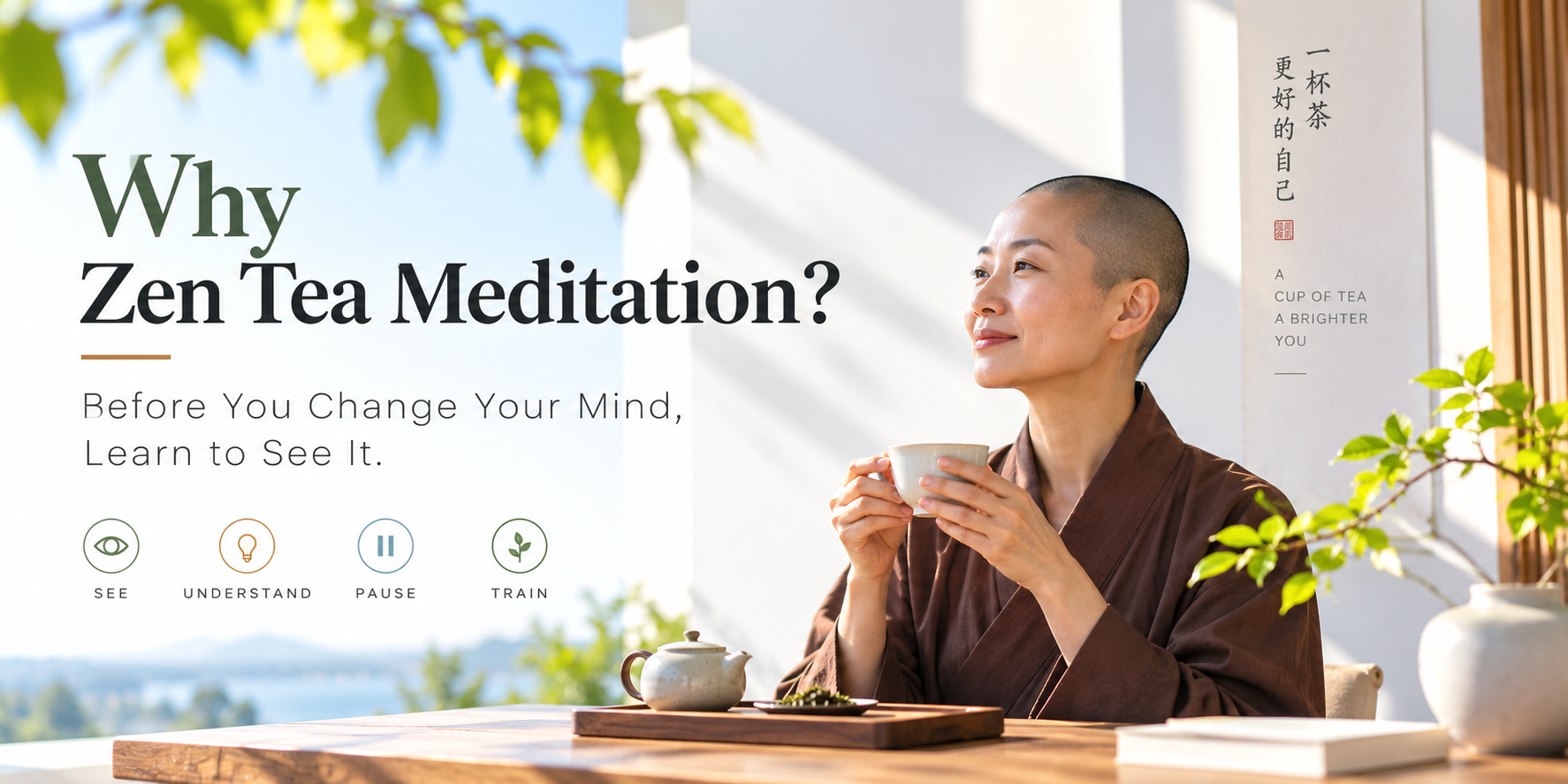
Why Zen Tea Meditation?
Why Zen Tea Meditation? Zen Tea Meditation uses the simple experience of drinking tea to help us observe the mind as it really is. By noticing what we see, hear, smell, taste, feel, and think, we begin to recognize when the mind wanders, where it goes, and how thoughts and reactions arise. Before we try to change or train the mind, Zen Tea Meditation teaches us to first see and understand it through direct experience.#ZenTeaMeditation #ZenTeaAwareness #Meditation #AwarenessPractice #Mindfulness #MindAwareness #MindWandering #AttentionTraining #SelfObservation #DirectExperience #TeaMeditation #UnderstandingTheMind #PresentMomentAwareness #MeditationPractice #MindfulTeaDrinking
Before You Change Your Mind, Learn to See It.
Most of us have moments when we wish we could change our state of mind. When we are under pressure, we want to relax. When the mind is restless, we want it to become calm. When we are troubled by difficult thoughts or emotions, we want to find a way out. We often want to stop worrying, stop overthinking, become less reactive, or simply feel more at peace.
But before we try to change the mind, there is a very important question: Do we actually know what is happening in our mind right now?
We use our mind every moment of every day, yet we rarely stop to observe how it actually works. A thought appears, another thought follows it, a memory arises, a judgment is made, an emotion develops—and much of this happens so quickly that we hardly notice the process. We usually become aware only after we are already worried, angry, distracted, or caught in a train of thought.
This is why Zen Tea Meditation begins with awareness. Before we try to quiet, control, or change the mind, we first learn to see it.
Why Tea?
Tea gives us a simple and natural place to begin.
When we drink a cup of tea, many things are happening at the same time. Our eyes see the color of the tea and the shape of the leaves. Our ears hear the sound of water and teaware. Our nose notices aroma. Our tongue experiences taste. Our hands feel the warmth of the cup, and our body experiences different sensations.
At the same time, the mind is also active.
We may be listening to the sound of water and suddenly begin thinking about work. We may be looking at the tea and suddenly remember someone. Before the tea even reaches our mouth, a thought may already appear: “The color is so dark. It is probably going to be bitter.” After taking a sip, another thought may arise: “I don’t like this taste.”
Something very interesting has happened. “I taste bitterness” describes something we actually experienced through taste. “I don’t like it” is a reaction that appeared in the mind. “It is probably going to be bitter” appeared before we even tasted the tea—it was a prediction or a guess.
In everyday life, direct experience, thoughts, judgments, memories, and reactions happen so quickly that we often mix them together. Through the simple act of drinking tea, Zen Tea Meditation gives us an opportunity to slow down and begin seeing these different processes for ourselves.
This is why tea is useful in the practice. The tea itself is not the final goal. Tea becomes a way to observe our own experience and, through that experience, to begin observing our own mind.
Before We Change the Mind, We Need Firsthand Information
In Buddhism, the Buddha is often called the “Great Physician.” A doctor helps us treat illnesses of the body. The Buddha taught people to recognize suffering and inner afflictions, understand how they arise, and learn how to work with them. From this perspective, learning to understand our own mind is a little like learning to become the doctor of our own mind.
Think about what happens when a doctor sees a patient. A good doctor does not immediately prescribe medicine. The doctor first needs to understand the patient’s actual condition. What symptoms are present? When did they begin? What has changed? The doctor gathers accurate firsthand information before looking for causes, making a diagnosis, and deciding what should be done.
If the information collected at the beginning is inaccurate, or if a conclusion is reached before the facts are clearly understood, the diagnosis may be wrong. And if the diagnosis is wrong, the treatment may also be wrong.
The same principle applies when we begin learning about our own mind. If we have not yet clearly observed what is actually happening within us, it is difficult to understand why we think, feel, and react the way we do. And without that understanding, how do we know where to begin making a change?
So at the beginning of Zen Tea Meditation, we are not in a hurry to “fix” the mind. We first learn to become a careful observer of our own experience.

Observe As It Is. Be Aware As It Is. Record As It Is.
A very important principle in Zen Tea Meditation is to experience things as they actually are.
For now, we do not rush to judge our experience as good or bad. Instead, we begin with very simple questions: What am I actually seeing? What am I hearing? What am I smelling? What am I tasting? What sensations are arising in my body? What is appearing in my mind?
“As it is” means that whatever actually happened, we acknowledge it. Whatever we truly experienced, we accept that as our starting point. We do not turn guesses into facts, and we do not change our experience simply because we think another answer would sound better.
For example, if I look at the tea and see pale yellow, I recognize, “I see pale yellow,” and at the same time I know that I am looking. If I hear the sound of tea being poured, I know that I am hearing. If I take a sip and taste bitterness, I know that I am tasting bitterness.
Awareness also includes what happens in the mind. If the tea has not yet reached my mouth and I am already thinking, “This looks dark, so it must be bitter,” I can recognize that I have not actually tasted bitterness yet. What appeared was a thought or a guess. If I take a sip and think, “I don’t like this,” I can begin to distinguish between the bitterness that I tasted and the dislike that arose afterward in my mind.
And if, while drinking tea, my mind suddenly goes to dinner, work, a conversation, or something that happened yesterday, when I notice it I can simply recognize: “My mind wandered just now.”
Observing as it is does not mean that we are not allowed to have thoughts. It does not mean that the mind must never wander. It means that, as much as possible, we begin to know: What is happening right now? What am I doing? What is my mind doing?
Why Do We Record Our Experience?
In Zen Tea Meditation, we not only observe our experience; we also record what we actually noticed.
The Zen Tea Awareness Card serves a little like a doctor’s observation record. It helps us collect firsthand information about our own experience while drinking tea. We observe what is happening, become aware of what we are experiencing, and then record that experience as accurately as we can.
If I see pale yellow, I record, “I saw pale yellow.” If the cup feels warm in my hand, I record that warmth. If I taste a little bitterness, I record what I actually tasted. If I am not sure, I can write, “I’m not sure.” If something was only a guess, I can recognize it as a guess. If I discover that I was thinking about something else and only later realized my mind had wandered, I can record that too.
Even if I did not notice anything during part of the practice, that is also something I can honestly record: “I didn’t notice.”
There is no need to make up an answer, and there is no need to copy the teacher’s examples. The purpose is not to complete the card beautifully or to give the “correct” answer. The purpose is for our record to come as close as possible to what we actually experienced.
Your Body Is Here. But Where Is Your Mind?
After completing even a very simple Zen Tea practice, many people may discover something surprisingly important: just because our body is here does not mean that our mind is always here.
We may be sitting quietly with a cup of tea in front of us. Our body has not moved. But while listening to the sound of water, we suddenly begin thinking about something else. While looking at the tea, someone comes to mind. As soon as the tea enters the mouth, the mind begins judging whether it tastes good or bad. One thought leads to another, and another thought leads to another. By the time we suddenly realize what has happened, the mind may already have traveled quite far.
The interesting thing is that this is not something that happens only during meditation. The mind is moving like this throughout our everyday life. We simply do not notice it very often. We may not know when it wandered, where it went, or what drew it away. Sometimes we are not even aware that it has wandered at all.
So when we suddenly recognize, “My mind wandered,” something important has already happened.
In the past, the mind may have wandered and we did not know. Now it wandered—and we saw it.
That is a very important beginning.

A Wandering Mind Is Not a Failure
People sometimes think that meditation means having no thoughts or keeping the mind perfectly still. When thoughts appear or the mind wanders, they may think, “I am not good at meditation.”
Zen Tea Meditation begins from a different understanding. Discovering that the mind has wandered is not a failure of the practice. The moment we recognize that it wandered is itself a moment of awareness.
Our mind is a little like a young child. A child needs someone to care for them, guide them, and help them gradually grow. If a young child were allowed to run anywhere without anyone noticing or caring where they had gone, we would naturally be concerned. Yet in everyday life, we often treat our own mind this way. We allow it to follow thoughts, memories, judgments, emotions, and things happening around us without even noticing where it has gone.
Zen Tea Meditation begins by changing this relationship with our own mind.
When we notice that the mind has wandered, we do not need to blame ourselves. It is like caring for a child who has wandered away. First, we notice where the child is. Then, gently and patiently, we guide the child back. We do this again and again.
As the practice develops, we can gradually learn to observe more: Did my mind wander? Where did it go? When did it begin to wander? What drew it away? And once I realize that it has wandered, how do I bring it back?
Through this gradual process, we begin not only to notice the mind, but also to understand it, care for it, guide it, and train it.
Why Does This Matter?
Because awareness creates the possibility of change.
If the mind wanders and we do not know that it has wandered, we have very little choice about what happens next. One thought can lead to another thought, one judgment to another judgment, one memory to another memory, and one emotional reaction to another. We may simply follow wherever the mind takes us.
But when we begin to see what is happening, a new possibility appears.
We can begin to understand our own patterns. We can notice when direct experience becomes judgment, when a thought turns into a chain of thoughts, when attention leaves the present experience, and when we begin reacting automatically.
And eventually, between what happens and how we respond, there may be a moment in which we can pause.
This is the deeper purpose behind:
SEE · UNDERSTAND · PAUSE · TRAIN.
We first learn to see what is happening. Through repeated observation, we begin to understand how our own mind works. With greater awareness, we create the possibility of pausing rather than automatically following every thought and reaction. And through continued practice, we gradually learn to guide and train the mind.

No One Can Observe Your Mind for You
Other people can teach us methods. Books can explain theories about the mind. A teacher can tell us that the mind wanders. But there is one thing no teacher can do:
No one can observe your mind for you.
You have to discover it through your own experience.
This is why Zen Tea Meditation does not begin with complicated ideas. It begins with something extraordinarily ordinary: a cup of tea.
Through seeing, hearing, smelling, tasting, feeling, and noticing the activity of the mind, we begin collecting firsthand information about ourselves. Gradually, we learn to distinguish direct experience from thoughts, judgments, memories, and reactions. We begin to notice when the mind leaves the present moment. And eventually, we learn how to bring it back.
From the moment we begin to notice our own mind, our mind is no longer completely unattended. We have begun to care for it.
See the present clearly. Notice where your mind goes. Learn to bring it back. Become the master of your own mind.
Zen Tea Meditation is not intended to diagnose or treat mental illness, and it is not a substitute for professional mental health care. It is a structured awareness practice that uses the simple experience of tea to help us observe our attention, sensory experience, thoughts, judgments, and reactions through direct personal experience.
Begin with a cup of tea. See it for yourself.
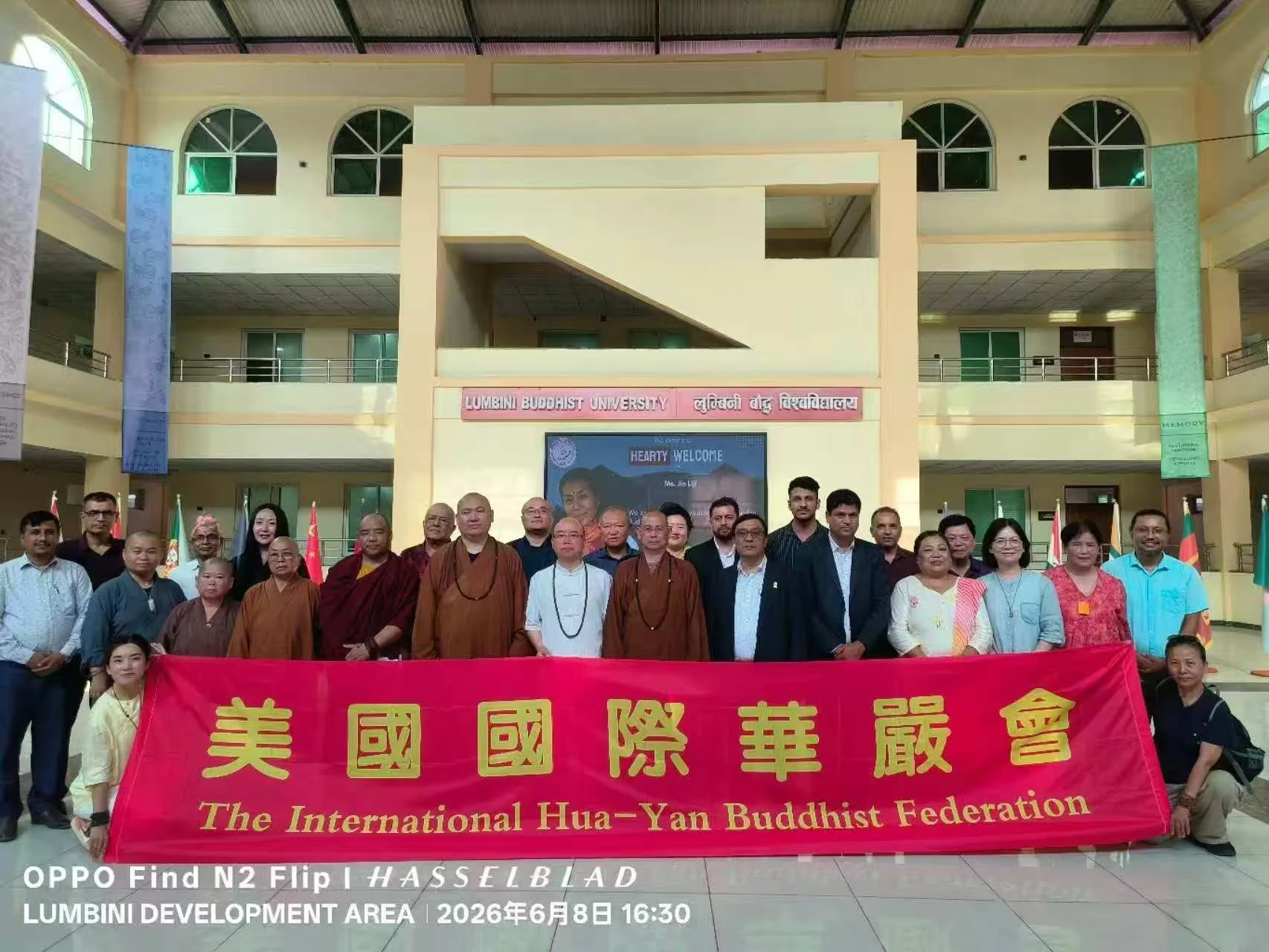
International Hua-Yan Buddhist Federation Visits Lumbini Buddhist University
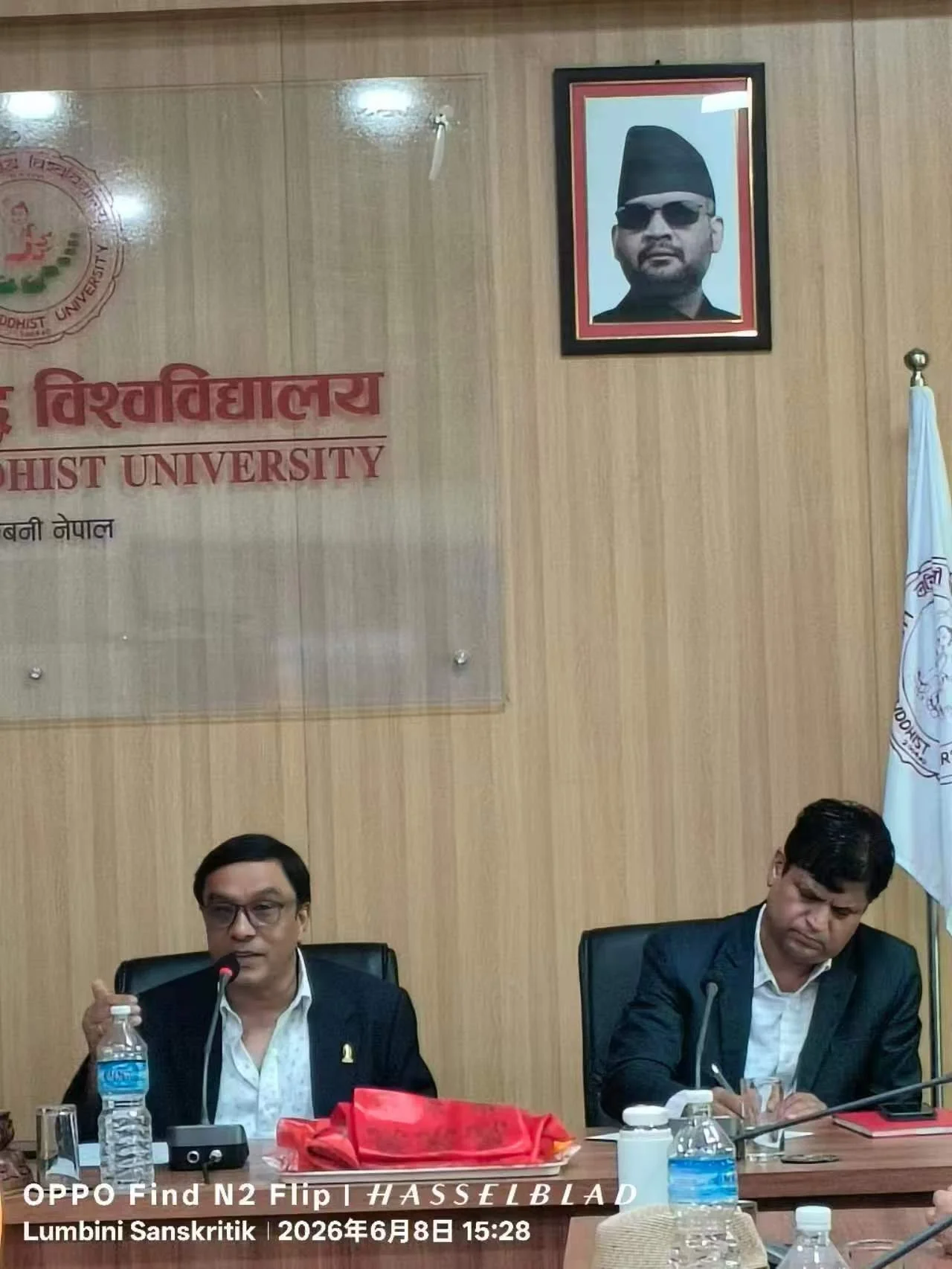
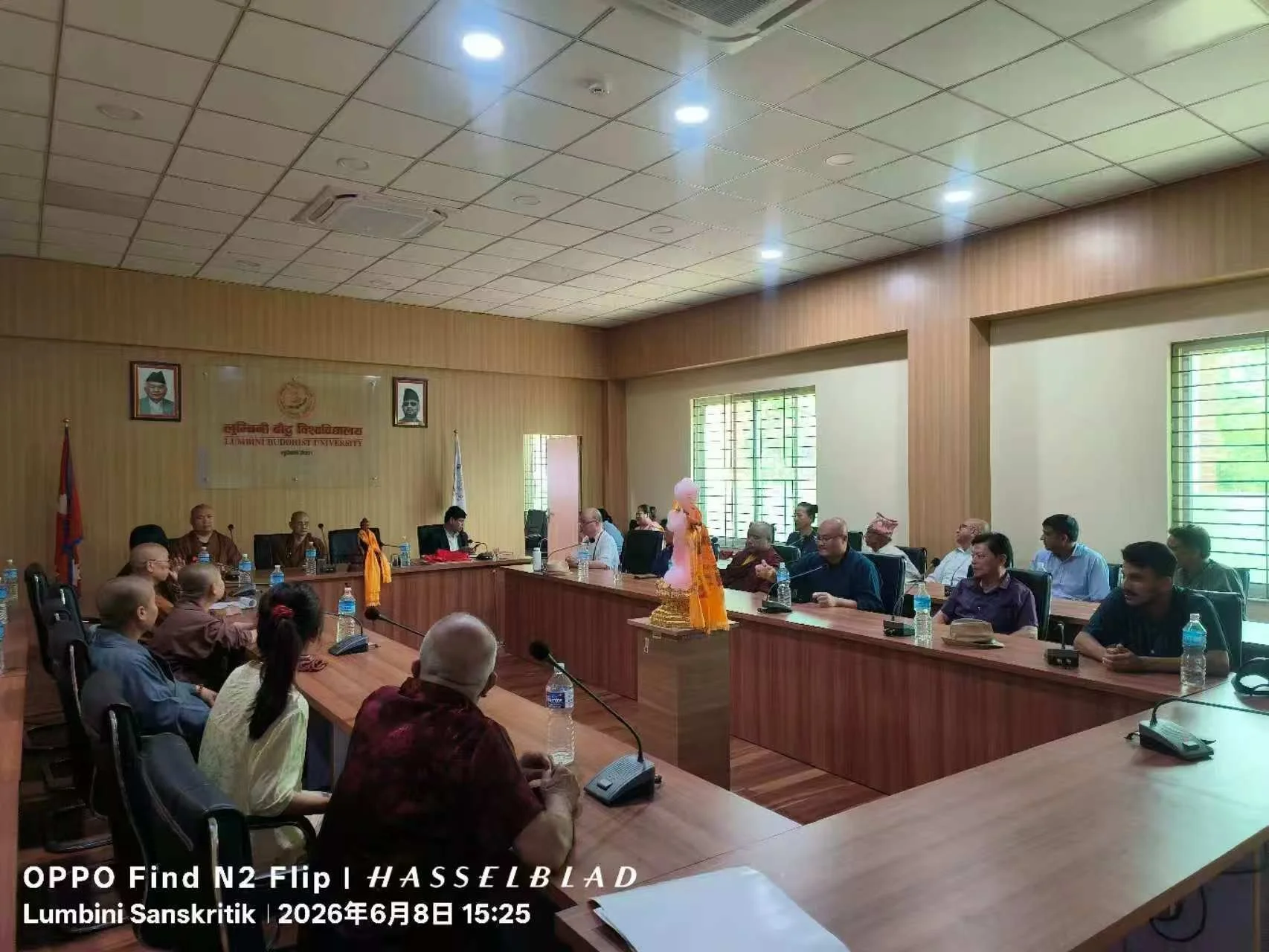
On June 8, 2026, the International Hua-Yan Buddhist Federation visited Lumbini Buddhist University in Nepal for a Buddhist cultural exchange featuring Dharma dialogue, Zen Tea Meditation, and the veneration of Buddha relics—bringing different Buddhist traditions together in the birthplace of the Buddha.
A Buddhist Cultural Exchange in the Birthplace of the Buddha
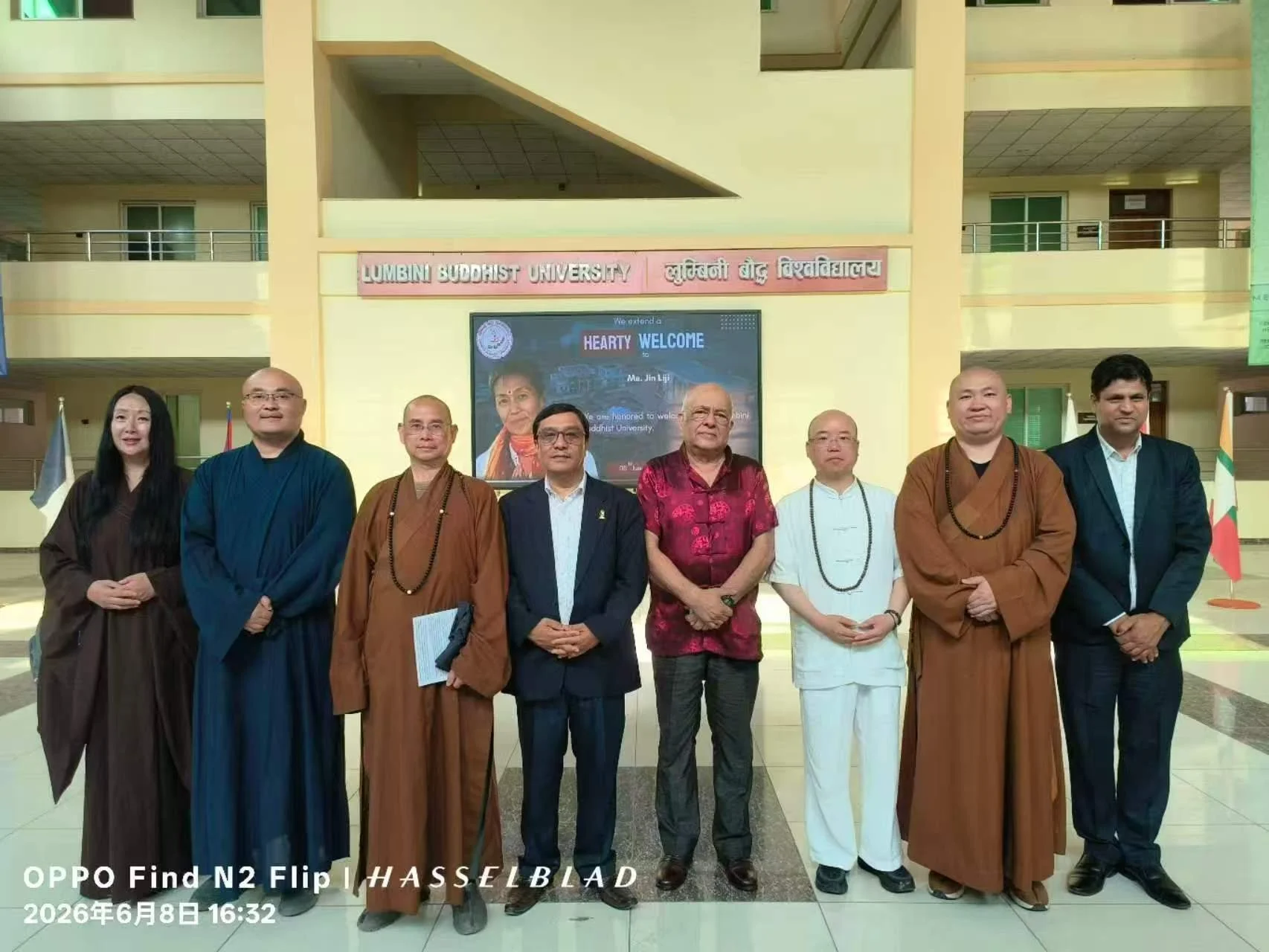
On June 8, 2026, the International Hua-Yan Buddhist Federation’s Nepal and Bhutan pilgrimage group arrived in Lumbini, Nepal—the birthplace of Shakyamuni Buddha. During the pilgrimage, the delegation visited Lumbini Buddhist University and joined the university in a Buddhist cultural exchange.
Lumbini is revered by Buddhists around the world as the birthplace of Shakyamuni Buddha. Coming to the Buddha’s birthplace was not only a pilgrimage, but also an opportunity for people from different countries and Buddhist traditions to meet, learn from one another, and share the Dharma.
The program opened with expressions of devotion rooted in the Chinese Buddhist tradition. Pingping Huang offered a Zen-inspired dance, followed by Venerable Yanxiang chanting a hymn in praise of Shakyamuni Buddha. Through movement and Buddhist chanting, the opening expressed reverence for and remembrance of the Buddha.
Representatives of the International Hua-Yan Buddhist Federation and Lumbini Buddhist University then delivered remarks and engaged in dialogue. Speakers from the visiting delegation included Venerable Zhengru, Venerable Zhilong, Mr. Xu Punan, and Mr. Chen Shaogong. On behalf of the university, Dr. Manik Ratna Shakya, President of Lumbini Buddhist University, together with the Vice President and other university representatives, welcomed the delegation and shared their perspectives. The exchange touched on Buddhist education, Buddhist culture, and opportunities for future international Buddhist cooperation.
Experiencing the Mind Through a Cup of Tea
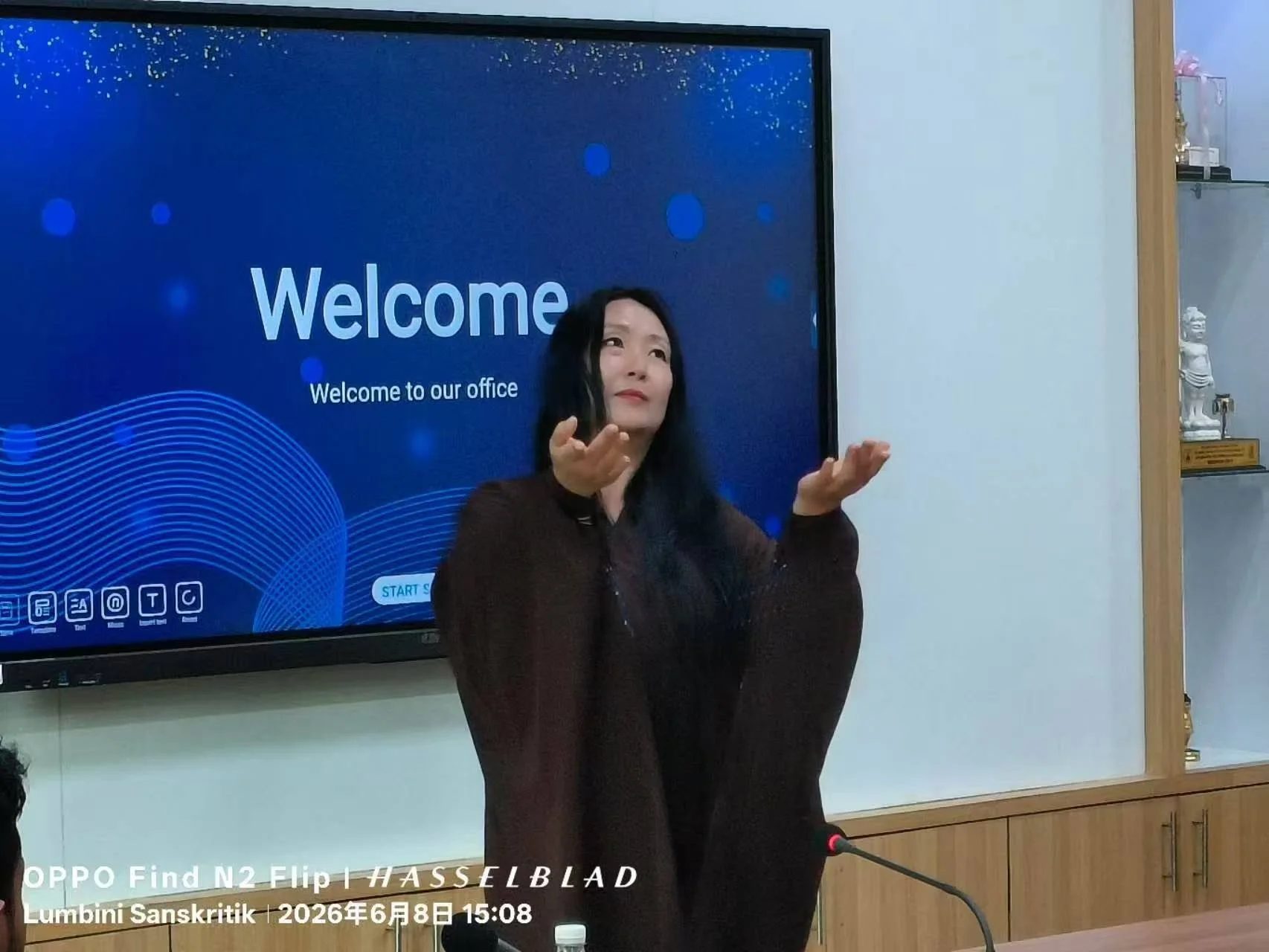
As part of the program, the International Hua-Yan Buddhist Federation invited guests, faculty, and students of Lumbini Buddhist University to experience Zen Tea Meditation, one of the Federation’s key initiatives.
Zen Tea Meditation is not simply about drinking tea, nor is it merely about learning a Buddhist concept. Using something as simple as a cup of tea, participants learn through direct experience to observe and discover how their own minds work.
Someone can tell us, “The mind wanders.” But that is only knowledge we have heard from someone else. When we are looking at a cup of tea and suddenly realize that we are thinking about something completely different; when we are listening to the sound of water and find ourselves lost in a memory; or when the tea touches our tongue and the mind immediately begins to like, dislike, compare, or judge—something different happens.
We see the activity of the mind for ourselves.
By looking at the tea, listening to the water, noticing its aroma and taste, and feeling sensations in the body, participants begin to observe their own attention, thoughts, and reactions:
Where is my mind right now? When does it wander? What draws it away?
This is at the heart of Zen Tea Meditation: understanding through direct personal experience. When we begin to see clearly how the mind moves, we can begin to understand it—and discover where meaningful change can begin.
In this way, the Zen Tea experience allowed the exchange to move beyond words and ideas into something everyone could experience directly together.
Different Traditions, a Shared Connection Through the Dharma
One moment during the gathering left a particularly warm impression. When the Chinese Buddhist delegation chanted the hymn in praise of Shakyamuni Buddha, representatives of Lumbini Buddhist University remarked that hearing a familiar praise of the Buddha gave them an immediate sense of closeness and connection.
Although we came from different countries, cultural backgrounds, and Buddhist traditions, our shared reverence for the Buddha and commitment to learning and practicing the Dharma naturally brought us together.
The language of the Dharma transcends these differences.
Following the exchange, the delegation had the precious opportunity to pay respects to relics of the Buddha. In the land where the Buddha was born, the journey—from visiting the sacred sites and meeting the faculty and students of Lumbini Buddhist University, to experiencing Zen Tea Meditation together and venerating the Buddha’s relics—became more than an outward pilgrimage. It became an inward journey of learning and practice.
The International Hua-Yan Buddhist Federation has long valued dialogue and exchange among different Buddhist traditions, countries, and cultures. This visit also created a meaningful connection between the Federation and Lumbini Buddhist University. Both sides expressed hope for further opportunities to cooperate in Buddhist education, cultural exchange, academic visits, and international Buddhist dialogue in the future.
Different countries. Different traditions. One cup of tea—and a shared experience of observing the mind.
From the birthplace of the Buddha, may the Dharma continue to be experienced, understood, and practiced in contemporary life.
Delegation Led by Venerable Jue Xing Visits The International Hua Yan Buddhist Federation
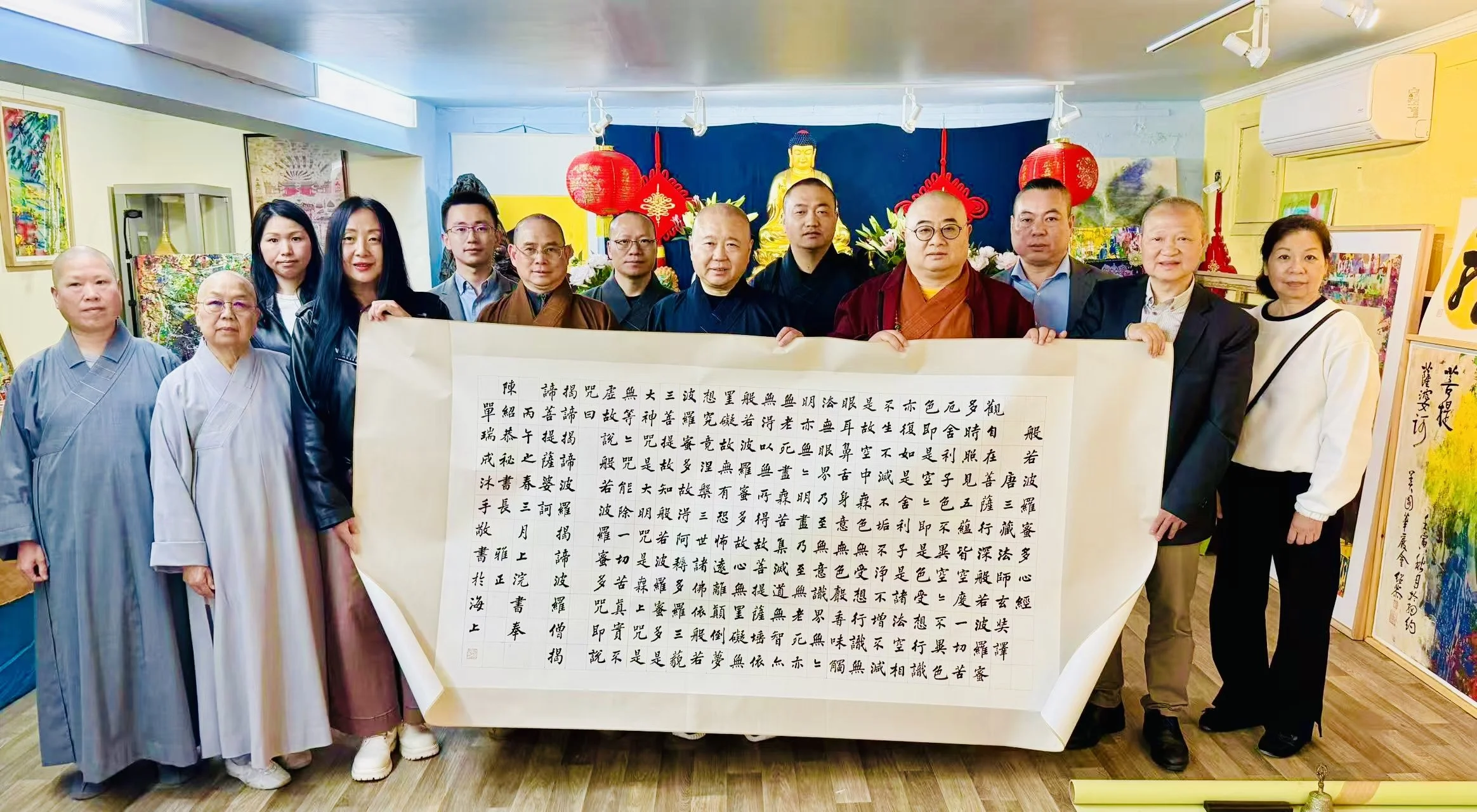
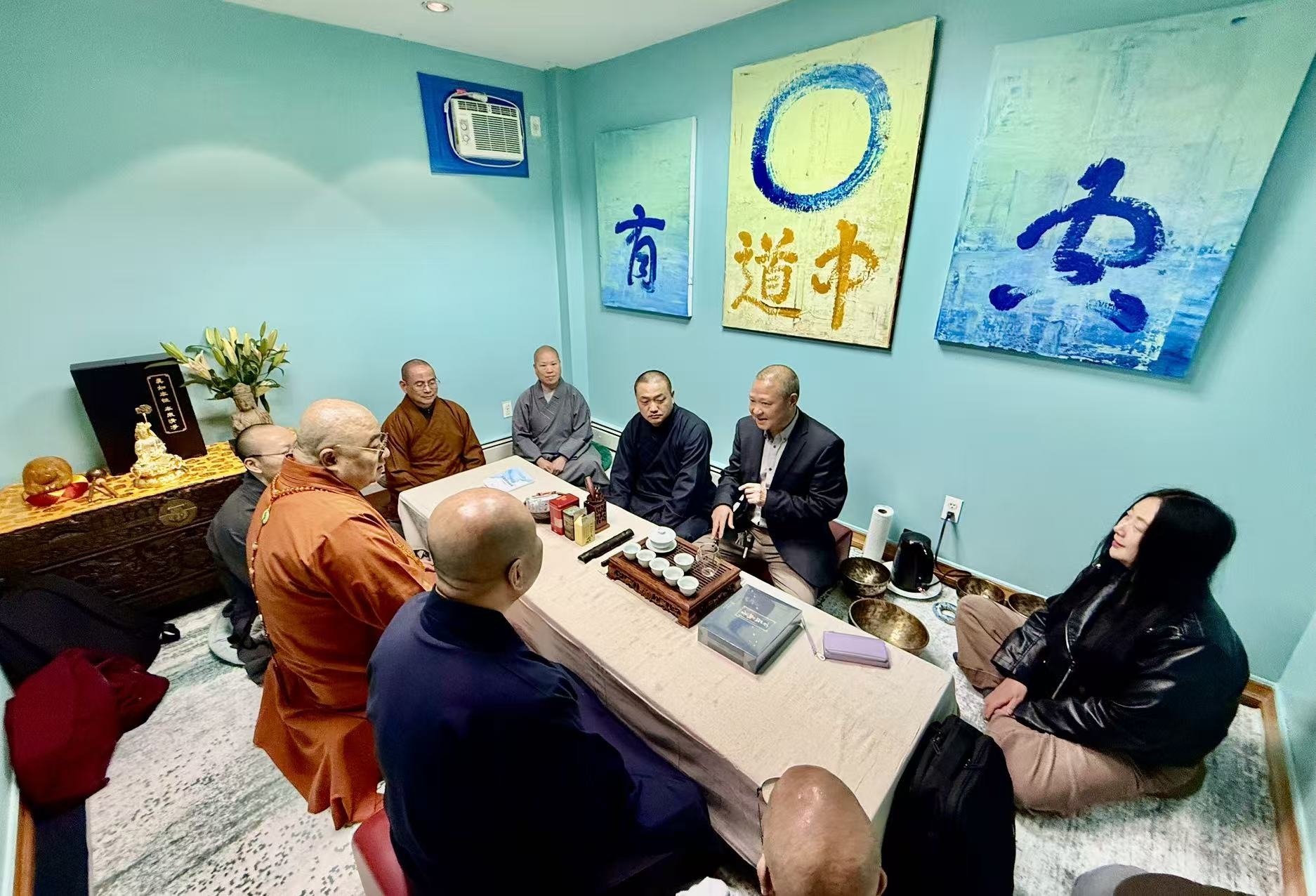
On May 12 local time, a delegation led by Venerable Jue Xing, Abbot of Shanghai Jade Buddha Temple, visited the New York lecture hall of The International Hua Yan Buddhist Federation for a cultural and Dharma exchange. The delegation was warmly received by Mr. Nanren Shi, President of the International Hua Yan Buddhist Federation, together with members of the community.
Both sides engaged in cordial exchanges in a solemn and harmonious atmosphere, sharing Dharma friendship and exchanging Heart Sutra calligraphy as commemorative gifts, symbolizing the continuation of Prajna wisdom and the enduring transmission of the Dharma lineage.
During the visit, the International Hua Yan Buddhist Federation specially arranged a Zen Tea cultural experience. In the peaceful and contemplative tea space, Venerable Jue Xing and the delegation joined the community in experiencing Zen Tea practice centered on “returning to the present moment, calming the six senses, and observing the mind inwardly.”
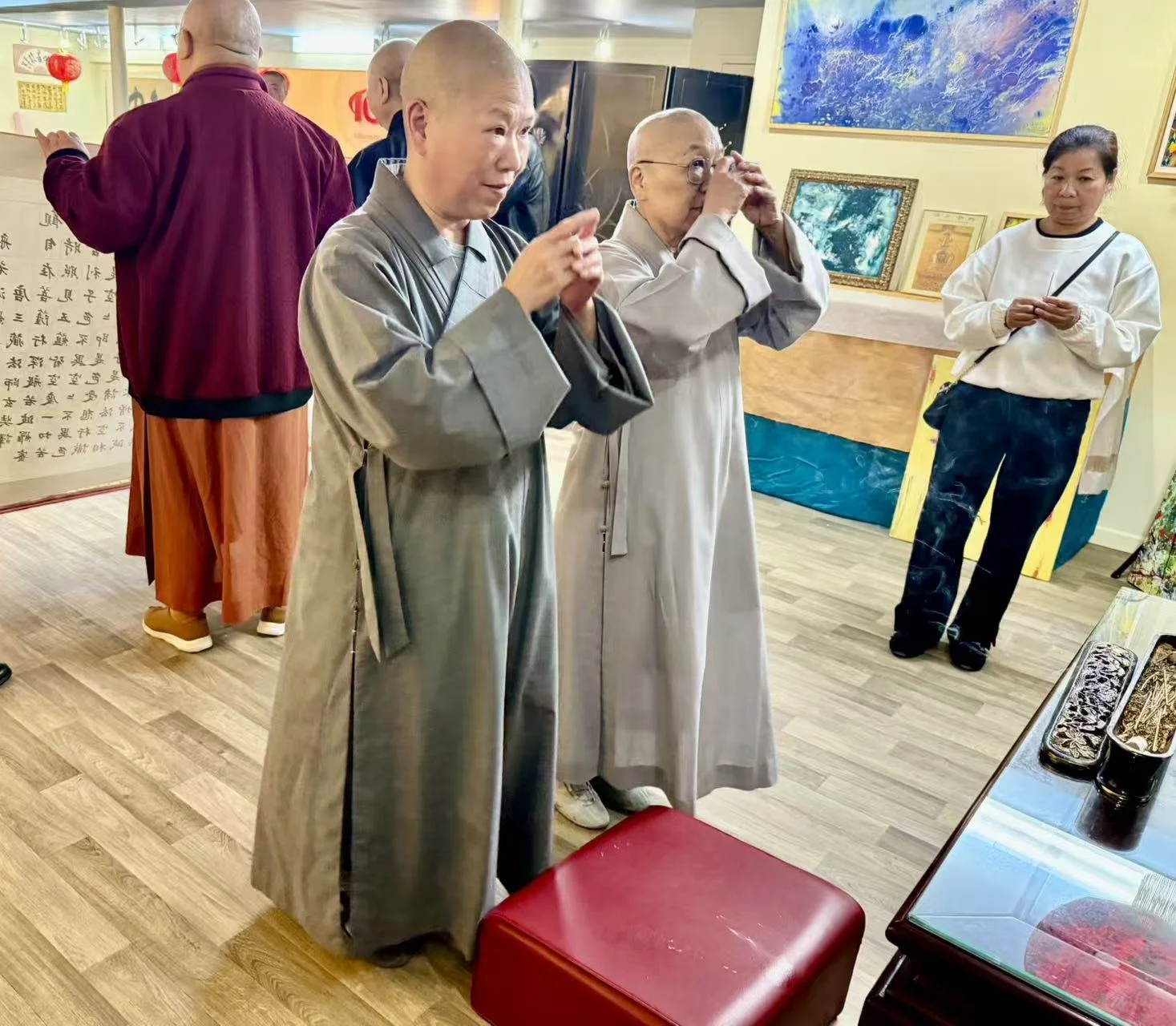
During the gathering, Venerable Jue Xing also offered guidance and encouragement regarding the Federation’s efforts in promoting Zen Tea culture and presenting Buddhist wisdom in ways that resonate with modern life, helping people rediscover inner peace and awareness. He also expressed appreciation for the role of Zen Tea in fostering cultural exchange between East and West and supporting emotional and spiritual well-being in contemporary society.
The entire exchange was filled with Dharma joy and harmony. Through a simple cup of tea, participants experienced the Buddhist spirit of present-moment awareness and self-reflection, while further deepening mutual understanding and cultural connection between the Buddhist communities of China and the United States.
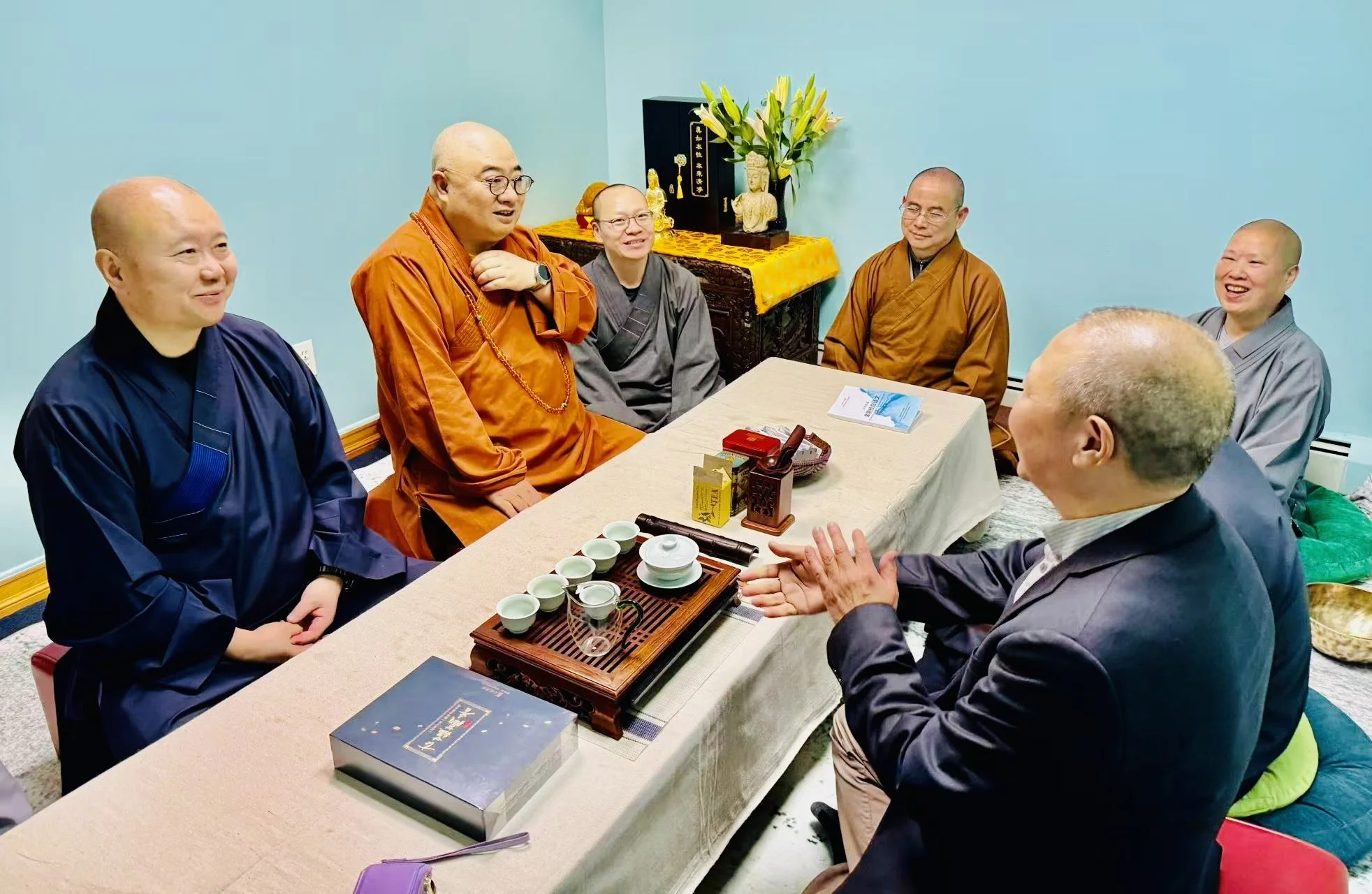
This visit not only reflected the profound Dharma friendship between Chinese and American Buddhist communities, but also demonstrated the relevance and vitality of Buddhist culture in modern society. Moving forward, the International Hua Yan Buddhist Federation will continue its mission of promoting Buddhist teachings, encouraging cultural exchange, and supporting spiritual well-being through approaches that are both meaningful and connected to contemporary life, benefiting more sentient beings.
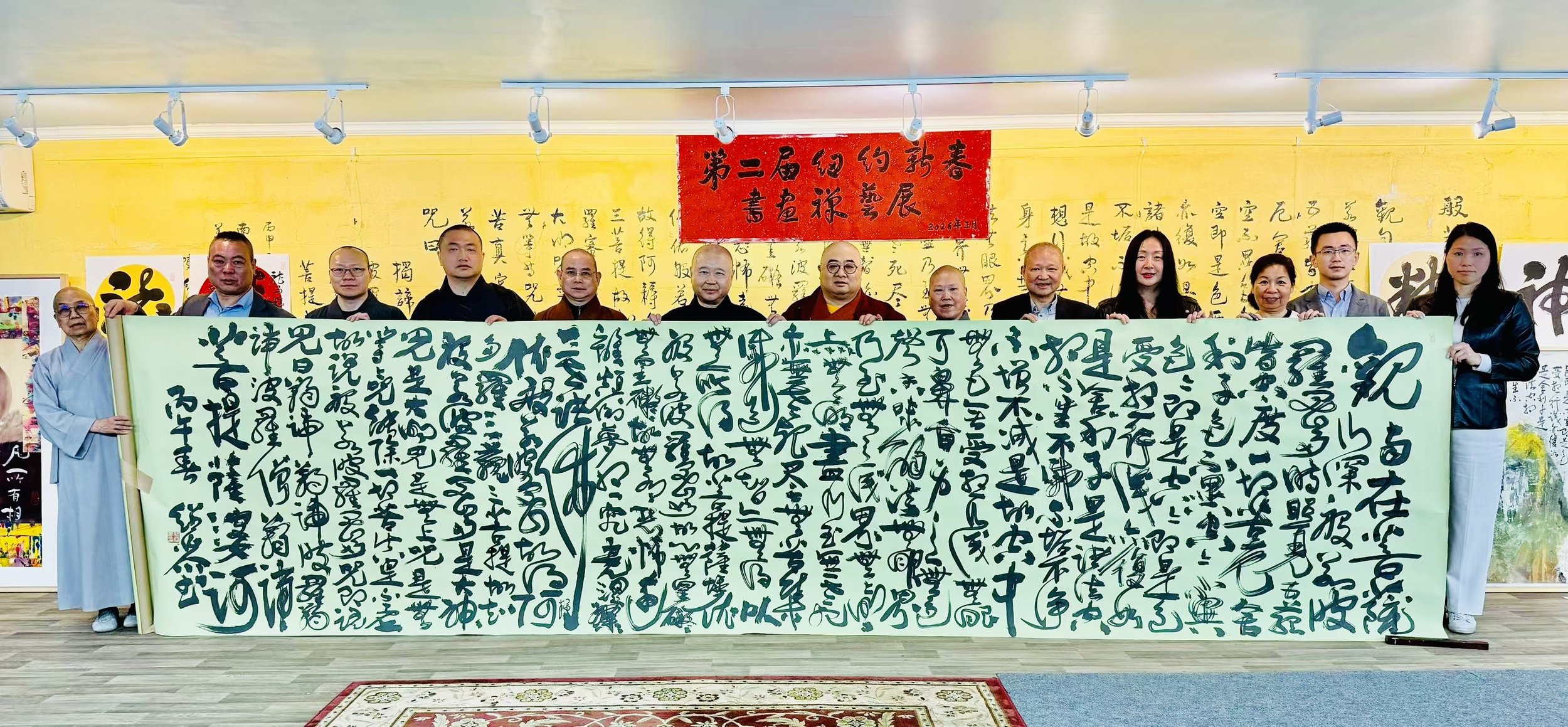
The Second New York Lunar New Year Calligraphy and Painting Exhibition: The Art of Mindfulness (2026)
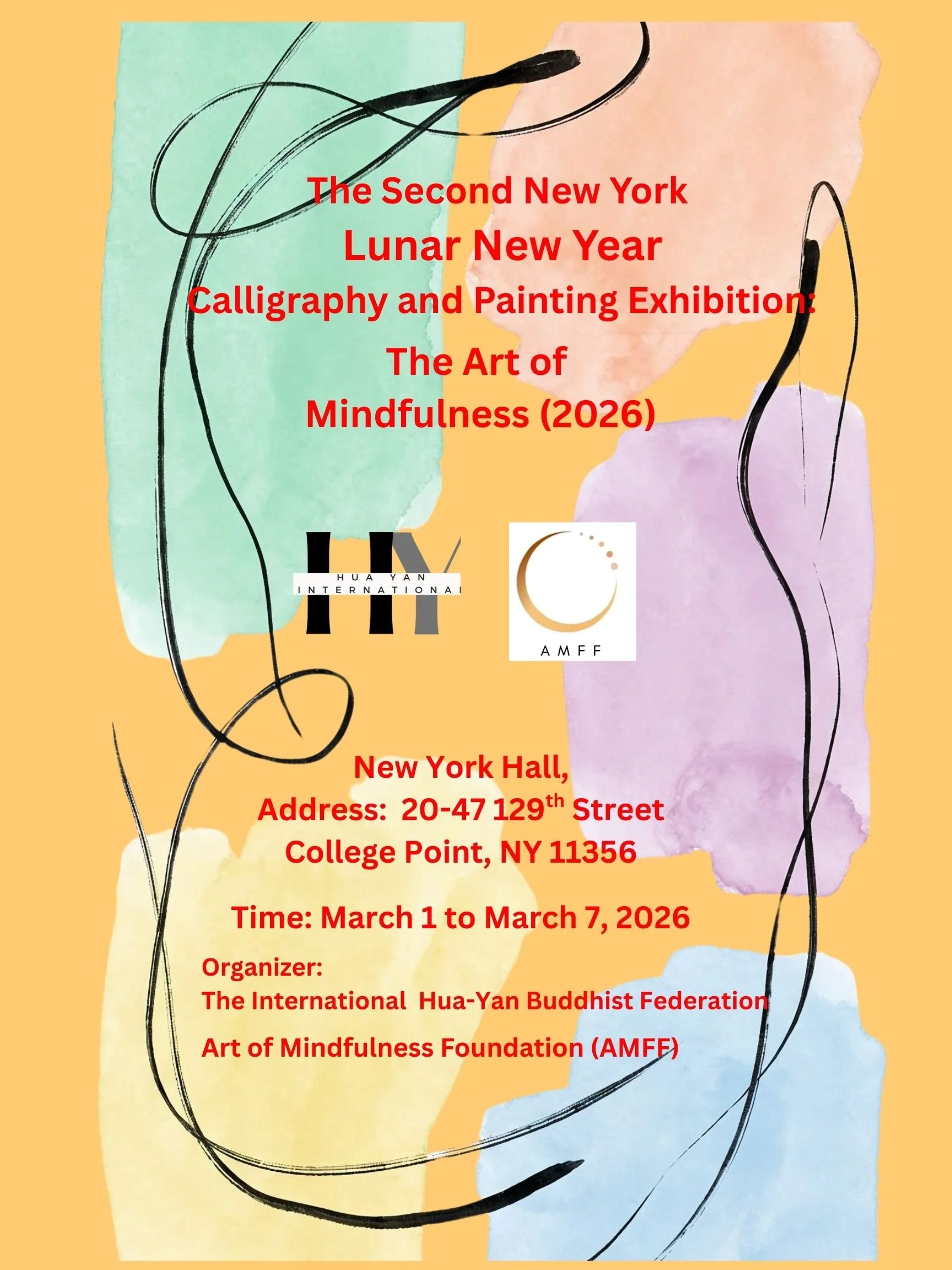
The Second New York Lunar New Year Calligraphy and Painting Exhibition: The Art of Mindfulness (2026) will be held from March 1 to March 7, 2026, at the New York Lecture Hall of the International Hua-Yan Buddhist Federation.
The exhibition is jointly presented by the International Hua-Yan Buddhist Federation and The Art of Mindfulness Foundation (AMFF).
The exhibition centers on “The Art of Mindfulness,” exploring art not as an abstract concept, but as a lived and embodied experience, expressed through the practices of calligraphy and painting.
The exhibition features works by Venerable Xianshu and lay practitioner Nanren Shi, Chairman of the International Hua-Yan Buddhist Federation, along with calligraphy and paintings by other highly accomplished Buddhist elders and practitioners.
Rather than emphasizing technical mastery or formal display, the works emerge naturally from states of concentration, awareness, and presence, revealing a deep integration of artistic expression and contemplative practice.
The opening ceremony will take place on Sunday, March 1, 2026, from 2:00 PM to 4:00 PM.
The opening program invites visitors to engage in quiet viewing and gentle exchange, allowing space to experience the inner clarity conveyed through calligraphy and painting.
Throughout the exhibition period, seated meditation experiences and singing bowl meditation experiences will also be offered. These guided sessions invite participants to slow down and return to the present moment through the interplay of visual art, breath, and sound, offering a direct encounter with the stillness and awareness embodied in the Art of Mindfulness.
More than an art exhibition, The Second New York Lunar New Year Calligraphy and Painting Exhibition: The Art of Mindfulness (2026) offers a moment of pause within urban life. In the spirit of the Lunar New Year, it invites visitors to reconnect with inner balance and quietude through the meeting of art and mindfulness.
Celebrating Guan Yin Bodhisattva’s Ordination Day & the 11th Anniversary of the International Hua-Yan Buddhist Federation

Date: November 8–9, 2025
Location: College Point, NY, USA
(Lunar Calendar: September 19–20, 2025)
This November, the International Hua-Yan Buddhist Federation will joyfully host two significant events in New York:
The Commemoration of Guan Yin Bodhisattva’s Ordination Day
The Federation’s 11th Anniversary Ceremony
These auspicious occasions mark not only milestones in our community’s journey but also moments for deep spiritual reflection and collective aspiration.
Honoring Guan Yin Bodhisattva
Guan Yin Bodhisattva, the embodiment of compassion, has long been revered as a guiding light for those who seek to relieve suffering and extend kindness without discrimination. On November 8, 2025, we will come together in reverence, chanting and offering heartfelt prayers, expressing our gratitude for the Bodhisattva’s vows and boundless compassion.
Celebrating 11 Years of Hua-Yan Federation
Since its founding, the International Hua-Yan Buddhist Federation has dedicated itself to integrating Buddhist wisdom into modern life—through Dharma education, meditation practice, cultural exchange, and humanitarian service. Over the past 11 years, we have built bridges between East and West, nurturing a shared understanding of compassion and wisdom across cultures. This anniversary is not only a celebration of our past efforts but also a renewal of our vow to serve all sentient beings.


Special Dharma Lectures on the Heart Sutra
As part of this year’s events, we are honored to invite Venerable Khenpo Ngawang Dorje Lama to deliver a series of lectures on the Heart Sutra (心经). Known for its concise yet profound expression of Buddhist wisdom, the Heart Sutra is a gateway to understanding emptiness, interdependence, and the nature of ultimate reality.
On November 9, 2025, the Heart Sutra Discussion Forum will bring together Dharma teachers and practitioners to exchange insights and engage in meaningful dialogue. Confirmed participants include Venerable Zhengru, Vice President of the American Buddhist Confederation, who ordained at the age of 13 and has many years of deep cultivation and Dharma teaching experience; Mr. Nanren Shi, President of the International Hua-Yan Buddhist Federation and Secretary General of the American Buddhist Confederation, a former monk who graduated from a Buddhist academy and taught there for many years; and Ms. Pingping Huang, Secretary General of the International Hua-Yan Buddhist Federation, a long-time Buddhist practitioner who has published and translated the Diamond Sutra into modern Chinese, dedicated to making the Dharma accessible and ensuring its transmission, among others.
Through these discussions, we aim to deepen our understanding of the sutra’s timeless teachings and explore their relevance in navigating the complexities of contemporary life.
A Gathering of Heart and Mind
These two days of practice, learning, and fellowship will be more than a series of ceremonies—they will be a living expression of the Dharma. We welcome friends from all walks of life to join us in honoring Guan Yin Bodhisattva, celebrating our shared journey, and dedicating merit for the peace and well-being of all beings.

Bathing the Buddha and Ringing the Peace Bell Resonate in Times Square, Praying for World Peace


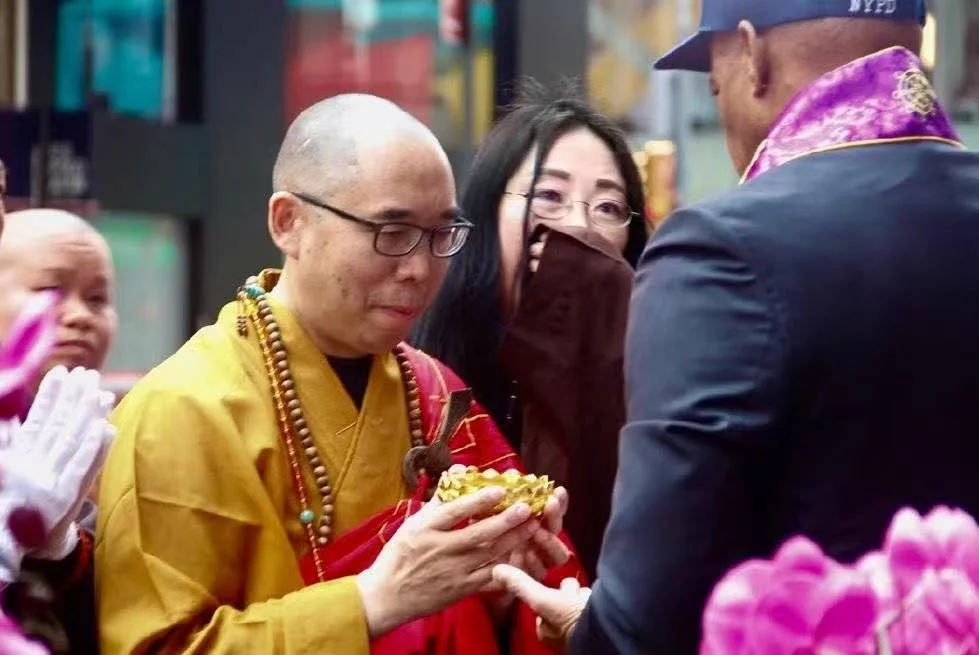
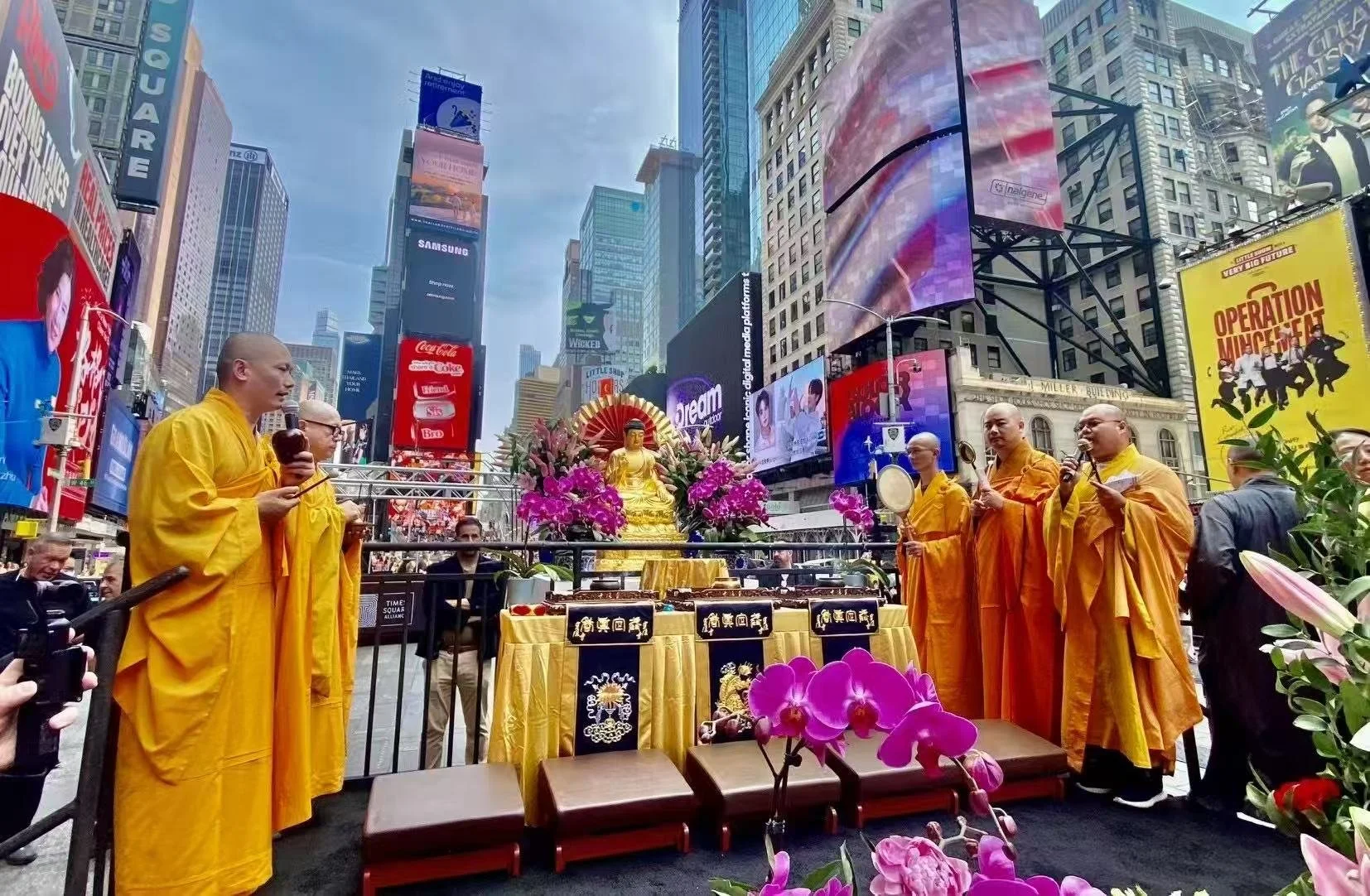
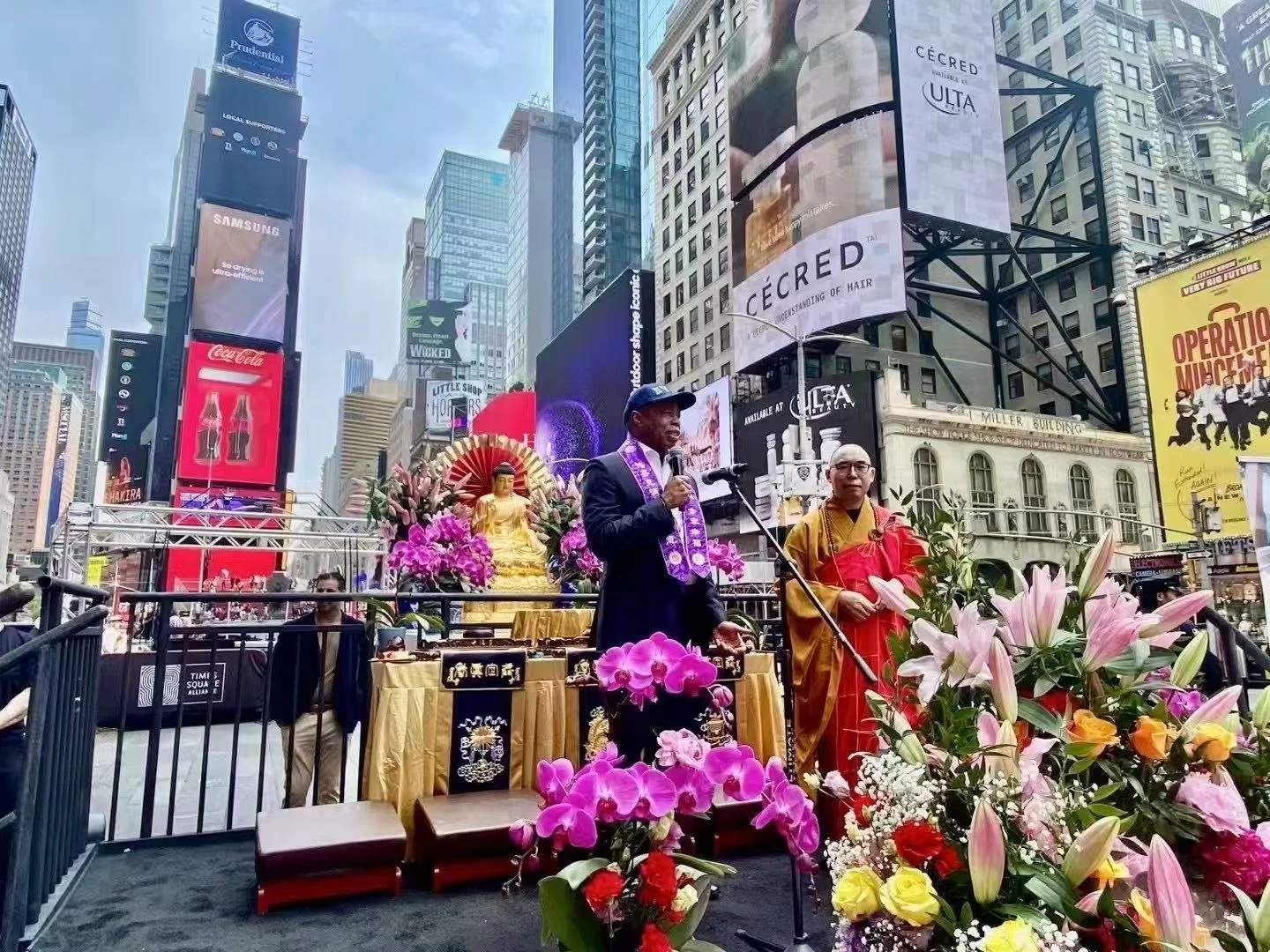
On May 4 this year, the American Buddhist Confederation solemnly held a Bathing the Buddha ceremony in New York’s Times Square to celebrate the Buddha’s birthday, and rang the Peace Bell to convey the message of compassion and wisdom to the world. The event also featured a special public display of the Buddha’s relics, attracting devotees and visitors to pay their respects and experience the solemnity and blessing of the Dharma.
New York City Mayor Eric Adams attended the event in person, joining the crowd in ringing the Peace Bell to echo the Buddha’s teaching—maintaining inner purity and compassion in a troubled world. The resonant chimes symbolized the purification of the heart and prayers for the happiness and well-being of all beings.
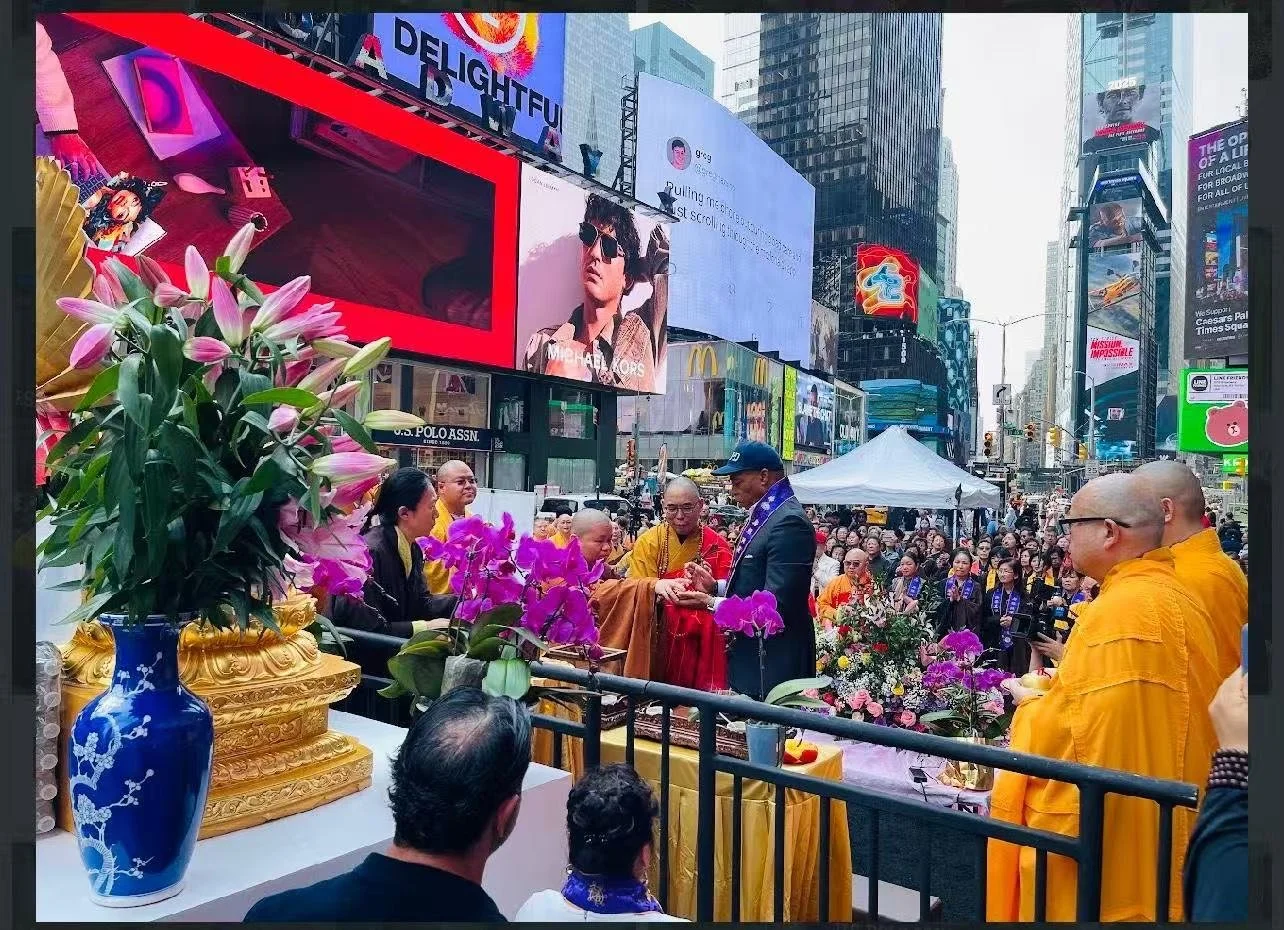
It is worth noting that Nanren Shi, President of the International Hua-Yan Buddhist Federation and Secretary-General of the American Buddhist Confederation, together with Pingping Huang, Secretary-General of the International Hua-Yan Buddhist Federation, also attended the event and served as chief planners. Their active involvement brought together the Bathing the Buddha ceremony, Buddha’s birthday celebration, Peace Bell ringing, and veneration of the Buddha’s relics into a successful and meaningful gathering.
This event not only allowed New Yorkers to experience the warmth and strength of Buddhist culture in the heart of the city, but also conveyed the universal values of peace, compassion, and wisdom to the world.
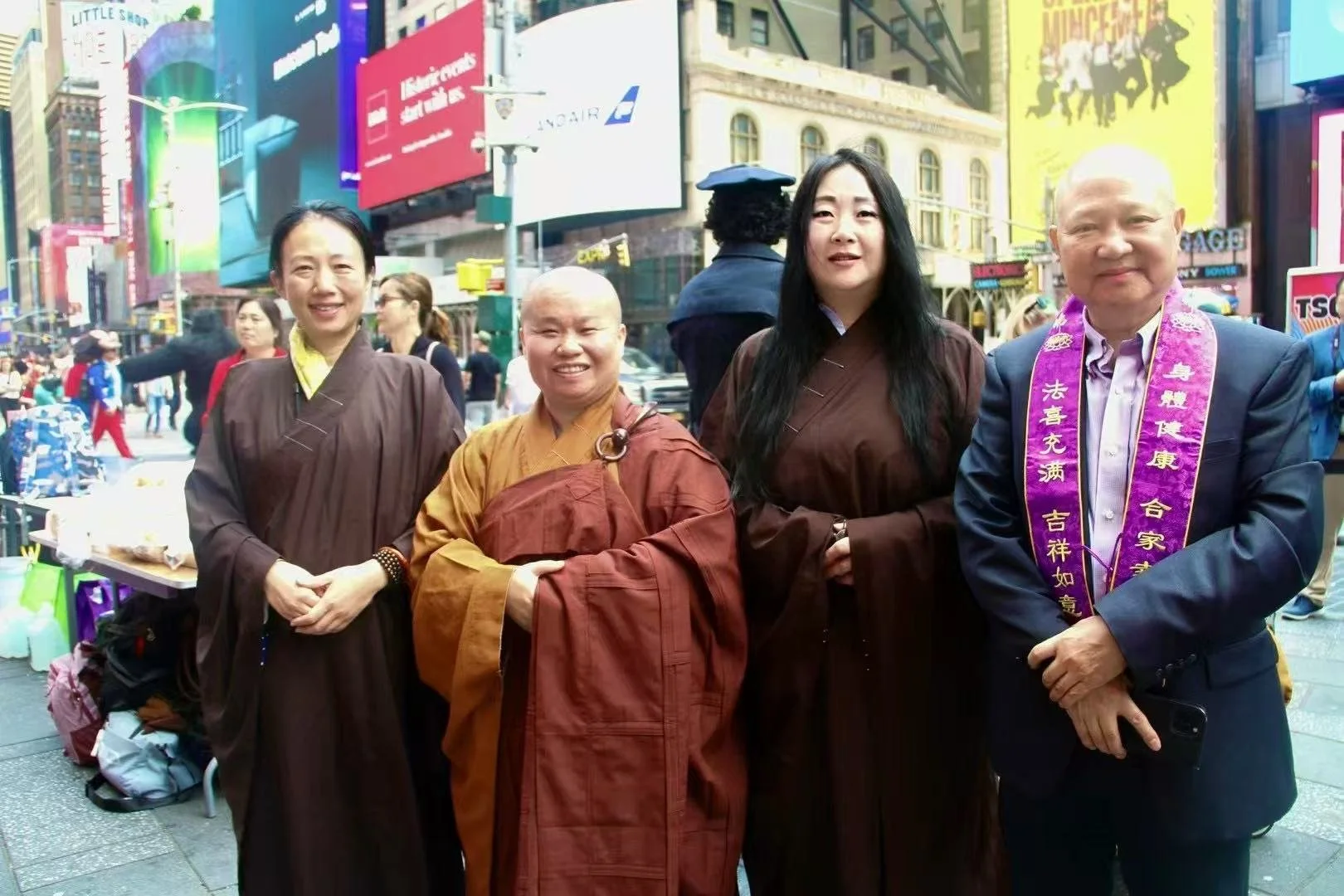

Chitwan Dream: The New Journey of Huayan Temple in Nepal
Recently, the Huayan Temple in Nepal welcomed four young novices, all hailing from Buddhist families in the Chitwan region.
Recently, the Huayan Temple in Nepal welcomed four young novices, all hailing from Buddhist families in the Chitwan region. To reassure the parents, Venerable Longben personally visited each family to discuss the children's ordination. Chitwan, located in the southern part of Nepal, translates to "heart of the jungle," boasting lush forests and serving as habitat to numerous exotic wildlife species. True to its name, the area exudes mystery and vitality.

After a bumpy journey, the children and Venerable Longben returned to the temple near the Kathmandu Stupa. For these youngsters, it was their first experience of such a long car ride, coupled with the discomfort of the journey, resulting in some of them feeling unwell and vomiting along the way.


Early the next morning, Venerable Longben took them to a monk's clothing store to purchase their robes. Upon their return to the temple, he performed the ordination ceremony, symbolized by the traditional head shaving. These children possess the karmic affinity for monastic life, a culmination of their accumulated merits from past lives. Under the protective gaze of the Dragon and Heaven , we rejoice and marvel at their auspicious connections.


Life within the temple is governed by strict rules. For these children, every aspect of life, from eating to using the restroom, walking, talking, and even praying, must be learned anew. While older children could assist newcomers, most of them are currently studying in India, leaving Venerable Longben to personally demonstrate each practice to the newcomers. This rigorous process is not just a matter of discipline but also a journey of growth and learning for the children. As they mature, these experiences will become cherished memories of their formative years.

We express our heartfelt gratitude to the supporters and benefactors of the International Huayan Association for their unwavering support in our Huayan endeavors. The healthy growth of these young novices is a testament to your virtuous deeds. Sincere thanks to all.

Why Should We Learn to Maintain Mindfulness in Our Own Lives?

In today's fast-paced life, we often find ourselves caught in endless whirls of thoughts and inner dialogues, often leading to feelings of anxiety and distress. However, we can harness a powerful tool to combat this mental chaos and embark on a healthier, happier lifestyle: mindfulness. By integrating mindful self-dialogue into our daily lives, we can unleash the potential of our subconscious, promote positive change, enhance happiness, and improve our overall quality of life.
At the core of mindfulness is consciously directing our attention to the present moment and accepting it without judgment, while cultivating higher levels of awareness. When applied to self-dialogue, mindfulness becomes a potent tool for self-improvement, empowering individuals to manage their inner conversations.
Mindful self-dialogue involves consciously monitoring our inner dialogue, keenly aware of the constant stream of thoughts in our minds, ensuring that these thoughts align harmoniously with our values and goals. Through engaging in mindful self-dialogue, individuals cultivate healthier cognitive patterns, gradually perfecting themselves, thereby catalyzing happiness and enhancing well-being.
Healthy self-dialogue constitutes an integral part of mindful self-dialogue. It includes identifying and challenging negative thoughts, replacing them with more constructive and affirmative alternatives. This practice empowers individuals to break free from self-destructive behaviors, fostering healthier and more beneficial self-relationships. By consistently engaging in healthy self-dialogue, individuals can boost self-esteem, alleviate anxiety, and cultivate resilience when facing adversities, facilitating positive life transformations.
Mindful self-dialogue not only alters our thinking patterns but also significantly enhances our overall sense of happiness. Its positive impact permeates various aspects of life, including interpersonal relationships, careers, and overall life satisfaction.
Learning to maintain mindfulness in our own lives has several benefits:
1. **Reduce Stress:** Maintaining mindfulness helps us better cope with stress and anxiety, enabling us to face life's challenges with greater calmness and composure.
2. **Enhance Focus:** Mindfulness training helps improve our concentration and attention, making it easier for us to focus on tasks and handle daily affairs.
3. **Increase Happiness:** By maintaining mindfulness, we can more deeply experience and appreciate the beauty of life, thereby enhancing our sense of happiness and fulfillment.
4. **Improve Interpersonal Relationships:** Mindfulness training helps cultivate empathy and emotional intelligence, making us more sensitive to others' emotions and needs, thereby improving our relationships with others.
5. **Promote Mental Health:** Maintaining mindfulness helps reduce negative emotions and self-criticism, strengthening self-acceptance and emotional regulation abilities, thereby improving our mental health status.
In summary, learning to maintain mindfulness can lead us to live more calmly, attentively, and joyfully, helping us better cope with various challenges and difficulties in life.

The International Huayan Society is now accepting registrations for its Mindfulness and Art Therapy monthly course. The course is generally scheduled for the third Sunday of each month. The next session will take place on March 24, 2024, from 2:00 PM to 4:30 PM. The course includes:
- Walking Meditation: Introduction to walking meditation to help participants slow down and focus their attention.
- Guided Meditation: Body scanning meditation, as well as insight meditation.
- Mandala Art Therapy.
- Music Walking Meditation.
- Guided Mindfulness Tea Ceremony: Understanding the principles of Zen tea and its logical principles.
- Singing Bowl Chanting Therapy.
- Zen Meditation Guidance: Both online and offline guidance from meditation instructors and answering meditation-related questions.
Due to limited venue capacity and enrollment slots, interested individuals are encouraged to register early.


Manhattan Women* Faith Leaders Convene to Address Housing Crisis and Migrant Justice

New York, NY - March 6, 2024 - Today, amidst the backdrop of a mounting affordable housing crisis and pressing issues surrounding migrant justice, Manhattan's diverse community of women* faith leaders convened at the Riverside Church for the 2024 Manhattan Women* Faith Leaders Breakfast and Roundtable. Hosted by New York City Comptroller Brad Lander, the Interfaith Center of New York, and the Riverside Church, the event brought together leaders representing various faith traditions to explore innovative and compassionate approaches to addressing these critical challenges.
New York City is grappling with an escalating affordable housing crisis exacerbated by skyrocketing rents, evictions, and a lack of support for migrants. Against the backdrop of an uneven economic recovery from the COVID-19 pandemic, the need for collaborative and community-centered solutions has never been more urgent.

Faith leaders and their communities have long been at the forefront of addressing societal crises, from ensuring food security to promoting public safety. Women* faith leaders, in particular, offer unique perspectives and insights that can drive innovative and more humane approaches to housing and migrant justice.
During the gathering, attendees engaged in robust discussions and shared best practices aimed at fostering greater understanding and cooperation across faith lines. The event served as a platform for dialogue, collaboration, and solidarity as participants explored ways to leverage their collective influence and resources to effect positive change.
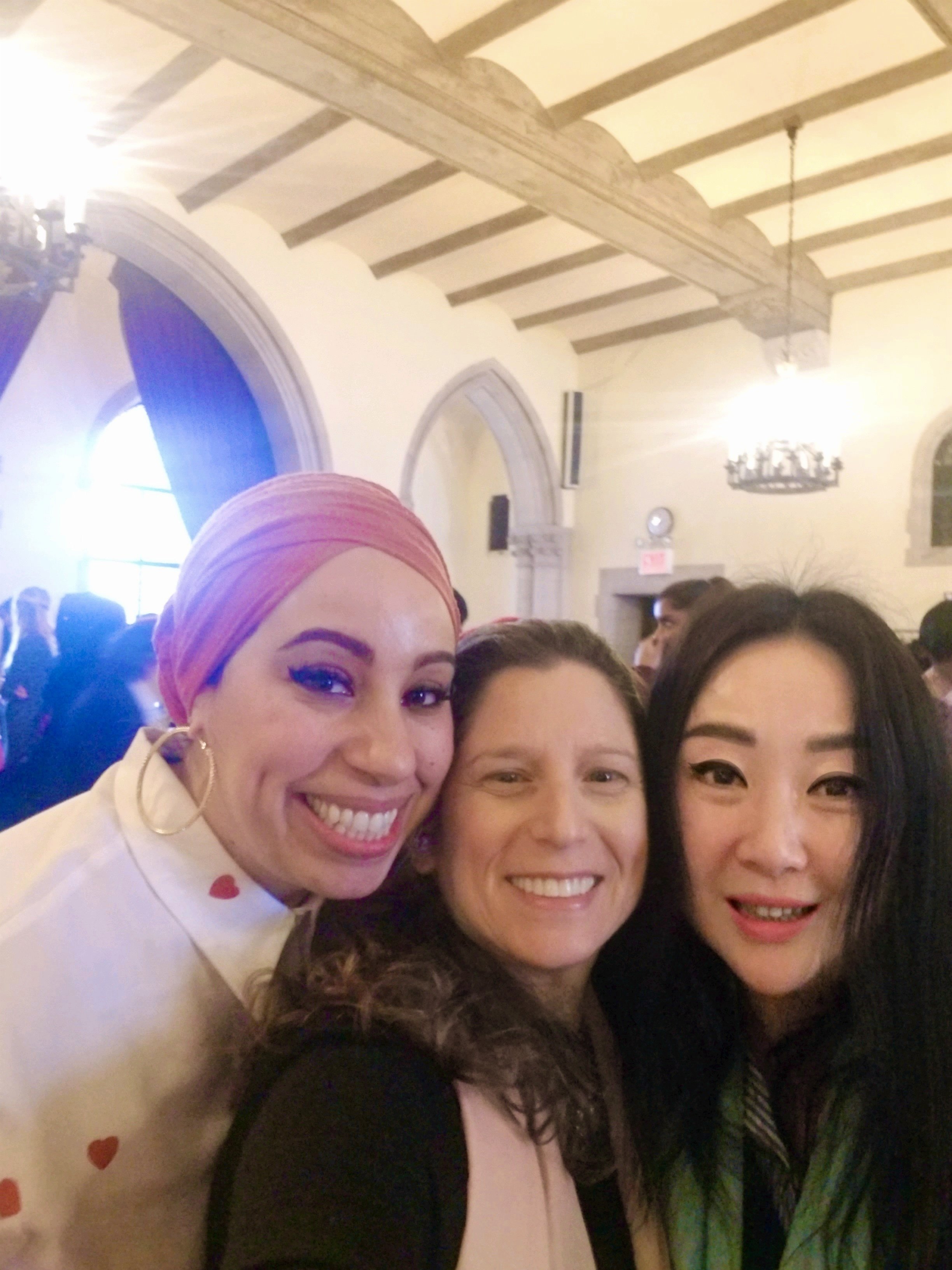
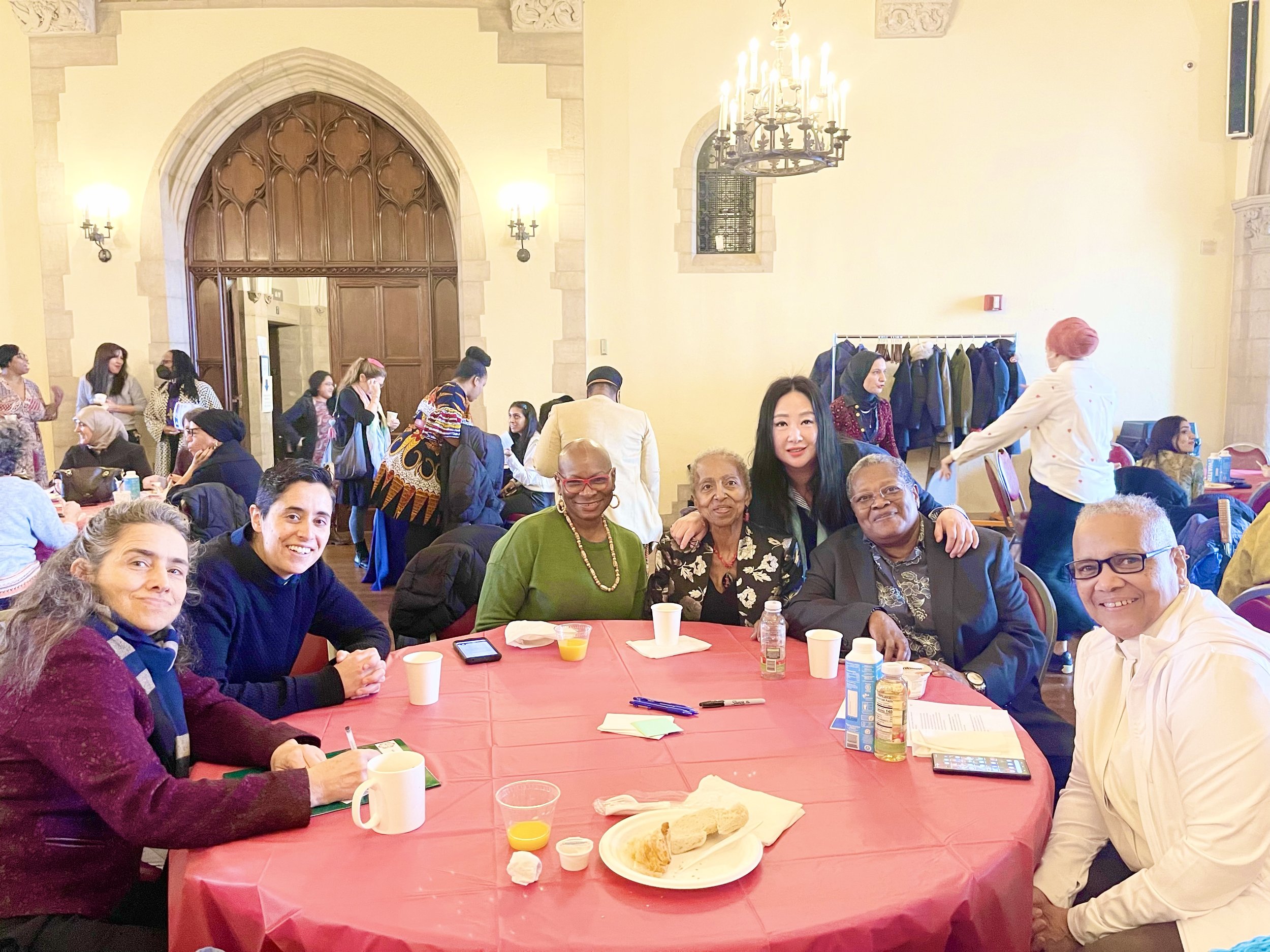
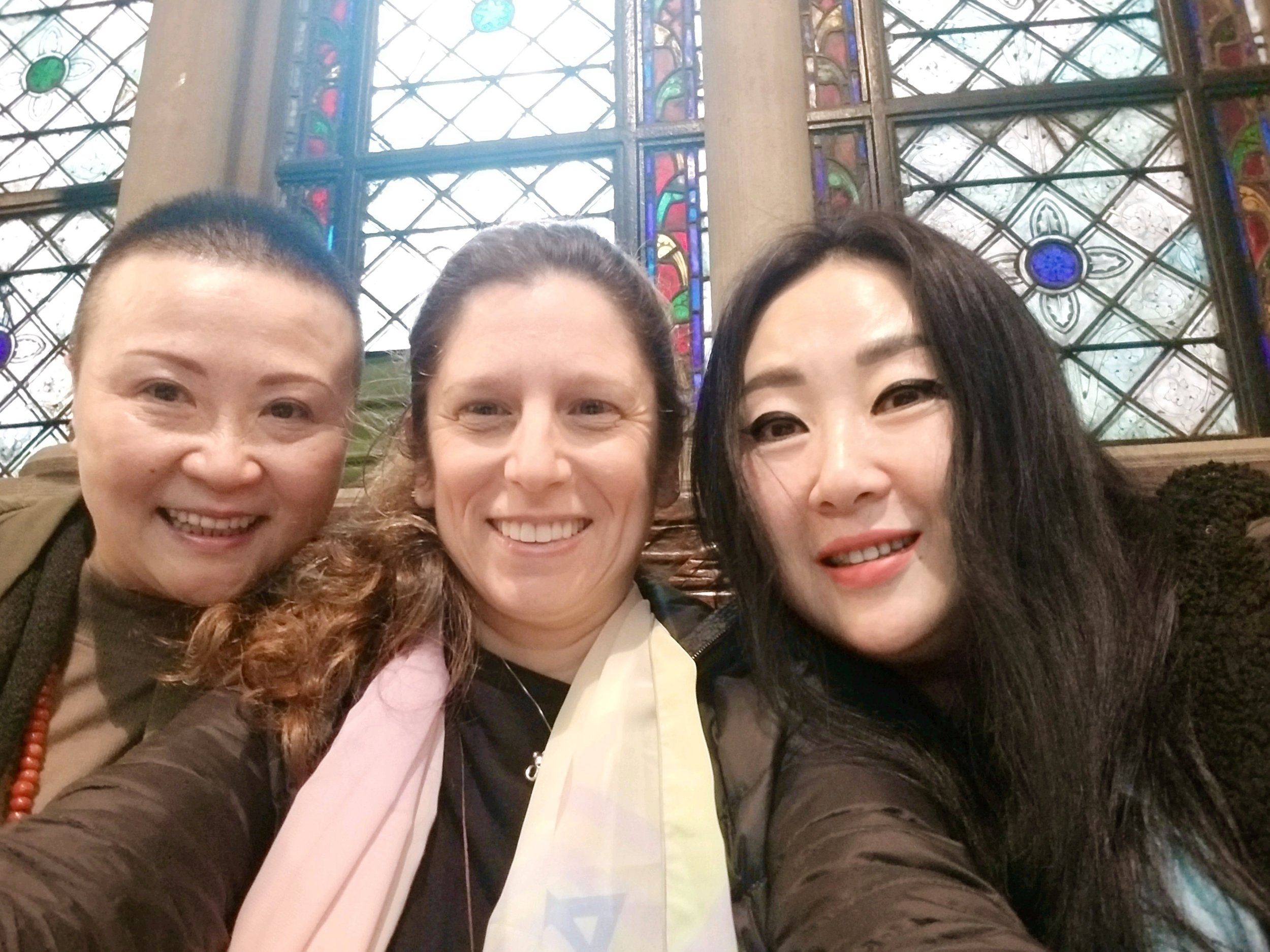
As a poignant conclusion to the event, Pingping Huang, the chief secretary of The International Hua-Yan Buddhist Federation, offered a closing prayer rooted in Buddhist tradition, underscoring the importance of spiritual unity and compassion in the pursuit of justice and equity.
In his remarks, New York City Comptroller Brad Lander emphasized the crucial role of faith communities in driving social change, stating, "Our city faces complex challenges, but by coming together across faith traditions, we can harness the power of collective action to build a more just and equitable society for all."
The 2024 Manhattan Women* Faith Leaders Breakfast and Roundtable underscored the vital role of women* faith leaders in shaping the future of our city and reaffirmed the commitment of participants to work collaboratively towards a more inclusive and compassionate society.