Tea as a Mirror of the Mind
How Zen Tea Meditation Helps Us Observe Attention, Thought, and Reaction
Zen Tea Meditation is not simply about drinking tea, and it is not simply about becoming calm. Tea is the medium. What we are really learning to observe and understand is the mind itself.
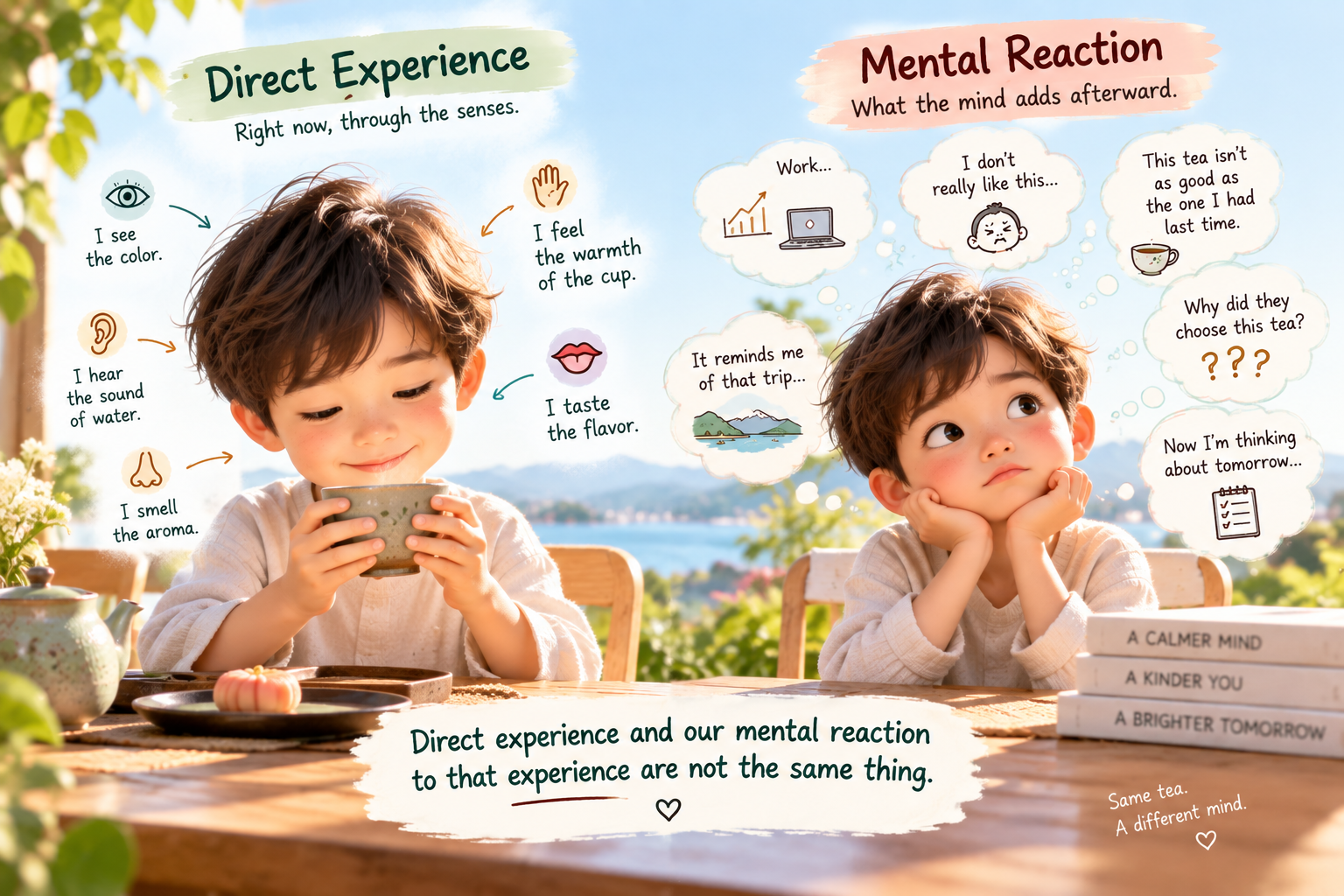
A cup of tea gives us something simple, concrete, and immediate to work with. We can see its color, hear the sound of water, smell its aroma, feel the warmth of the cup, and taste its flavor. All of these experiences are happening right here, in the present moment. Because the object is simple and clear, it becomes easier for us to notice what is happening in the mind at the same time.
For example, I may be listening to the sound of water, but suddenly realize that I am thinking about work. I may be looking at the color of the tea, but a moment later find myself remembering someone I met yesterday. Before the tea even reaches my mouth, I may already be thinking, “The color is so dark. It is probably going to be bitter.” Then, after taking a sip, another thought may arise: “I don’t like this taste.”
This is where the practice becomes interesting. The bitterness is something I actually tasted. “I don’t like it” is a reaction that appeared in my mind. “It is probably going to be bitter” appeared before I even tasted the tea—it was a prediction or a guess. In everyday life, direct experience, thoughts, judgments, memories, and reactions happen so quickly that we often experience them as if they were all the same thing. Zen Tea Meditation gives us an opportunity to slow down and begin seeing the difference.
The Tea Stays Here. The Mind Moves.
Tea also gives our attention a clear reference point. If I am listening to the sound of water, I know what my attention is with at that moment. If I suddenly realize that I am thinking about tomorrow’s schedule, I can recognize that my attention has moved away from the sound. If I am looking at the tea and suddenly begin thinking about another person, my body may still be sitting in exactly the same place, but my mind is no longer with what I am seeing.
Without a clear object, mind wandering can be difficult to notice. Tea makes the contrast easier to see. The tea stays here. The mind moves.
This leads us to one of the most basic questions in Zen Tea Meditation: Where is my attention right now? While looking at the tea, am I actually looking? While listening to water, am I really listening? While tasting the tea, am I still aware of the taste, or has my mind already moved to a memory, a judgment, a worry, or something I need to do later?
The purpose at this stage is not to force the mind to remain perfectly still. Before we can train attention, we first need to become aware of what attention is actually doing.
As we continue to observe, we may begin to notice not only that the mind wanders, but also when it begins to wander and what draws it away. Sometimes the cause is something outside us—a sound in the room, someone walking past, a phone notification, or a sudden movement. Sometimes it begins inside—a memory appears, a thought about work arises, a worry comes up, or a physical sensation catches our attention.
Sometimes the movement is extremely subtle. We taste bitterness and immediately think, “I don’t like this.” That thought reminds us of another tea we liked better. That tea reminds us of a place. The place reminds us of a person. A few moments later, although our body is still sitting in front of the same cup of tea, our mind has traveled somewhere completely different.
One thought has led to another, and another. Usually this happens so naturally and so quickly that we do not even realize we have left the original experience. Zen Tea Meditation allows us to begin seeing that process.

From Direct Experience to Thought and Reaction
One of the important things we gradually learn through this practice is that direct experience and our mental reaction to that experience are not the same thing.
Suppose I take a sip of tea and taste bitterness. The bitterness belongs to my direct sensory experience. Then the thought appears, “I don’t like this tea.” Now a reaction has arisen. A moment later I may think, “This tea is not as good as the tea I had last week.” Now memory and comparison have entered the experience. Then I may begin wondering why this particular tea was chosen, and the mind has moved even farther away from the original taste.
All of this may happen within only a few seconds.
Through practice, we begin to separate these layers and look at them more clearly. What did I actually see, hear, smell, taste, or feel? What thought appeared afterward? Did I immediately judge the experience? Did a memory arise? Did one thought lead to another? Where did my attention go?
These questions are not meant to be answered by analyzing ourselves intellectually. We are not trying to create a theory about our own mind. We are learning to observe what actually happens, in real time, through our own direct experience.
This is also why, at the beginning, Zen Tea Meditation does not ask us to immediately control the mind. If we are too eager to force the mind to behave in a particular way, we may miss the opportunity to see how it actually works. First, we observe. We notice when attention stays with the tea. We notice when it leaves. We notice what appears in the mind, what attracts our attention, what judgments arise, and what reactions follow.
Awareness comes before control.
Tea Does Not Create These Thoughts—It Helps Us See Them
The tea is not creating our mind wandering, memories, judgments, or reactions. These mental activities are already happening throughout our everyday lives. They happen while we are eating, walking, working, driving, talking to someone, or sitting quietly by ourselves.
The difference is that everyday life is usually complicated and fast. Many things are happening at once, so the movement of the mind can be difficult to see. Tea gives us a simpler environment. The cup remains in front of us. The sensory experience is clear. The pace slows down. Against this simpler background, the movement of attention and thought becomes easier to notice.
This is why tea can become a mirror of the mind.
A mirror does not create the face that appears in it. It simply allows us to see what is already there. In much the same way, tea does not create what is happening in our mind. It gives us a simple setting in which we can begin to see what was already happening.
At first, we may think we are learning to observe tea. We notice color, sound, aroma, warmth, and taste. But gradually, the focus begins to deepen. We start to notice our own attention. We notice when the mind leaves the present experience, where it goes, what draws it away, what happens after a thought appears, and whether we are aware of any of this while it is happening.
And something important changes the moment we notice.
There is a difference between the mind wandering without our knowing it and the mind wandering while we become aware that it has wandered. The mind may have wandered in both situations, but in the second situation, awareness is present.
That is why discovering that the mind has wandered is not necessarily a failure in Zen Tea Meditation. In fact, the moment we recognize, “My mind wandered,” the practice has already begun to work. Before, the mind wandered and we did not know. Now, it wanders—and we begin to see it.
Tea Is the Medium. The Mind Is the Practice.
As we continue practicing, repeated observation may gradually reveal patterns. Perhaps we notice that our attention is frequently pulled toward work. Perhaps certain sounds immediately irritate us. Perhaps we constantly compare what is happening now with something that happened in the past. Perhaps one uncomfortable sensation quickly produces a chain of worry. Or perhaps we discover how quickly the mind begins judging almost everything we experience.
These discoveries are valuable because they are not someone else’s description of our mind. They come from our own firsthand experience.
A teacher can guide us. A method can give us structure. A Zen Tea Awareness Card can help us record what we noticed. Books can explain how attention and thought work. But ultimately, no one can observe our mind for us. We have to see it for ourselves.
This is why what begins with something as ordinary as a cup of tea can gradually become something much deeper. Through tea, we learn to observe sensory experience. Through sensory experience, we begin to observe attention. Through attention, we discover mind wandering. Through mind wandering, we begin to see thoughts, memories, judgments, emotions, and reactions. Through repeated observation, we begin to recognize our own patterns.
Only when we begin to see these patterns clearly can we gradually learn how to work with them, how to bring the mind back, and eventually how to guide and train our own mind.
So although we begin with tea, tea is not where the practice ends.
Tea is the medium. The mind is the practice.
We look at the tea, listen to it, smell it, taste it, and feel it. But through this simple cup of tea, what we are gradually learning to see is our own mind.