From Awareness to Training
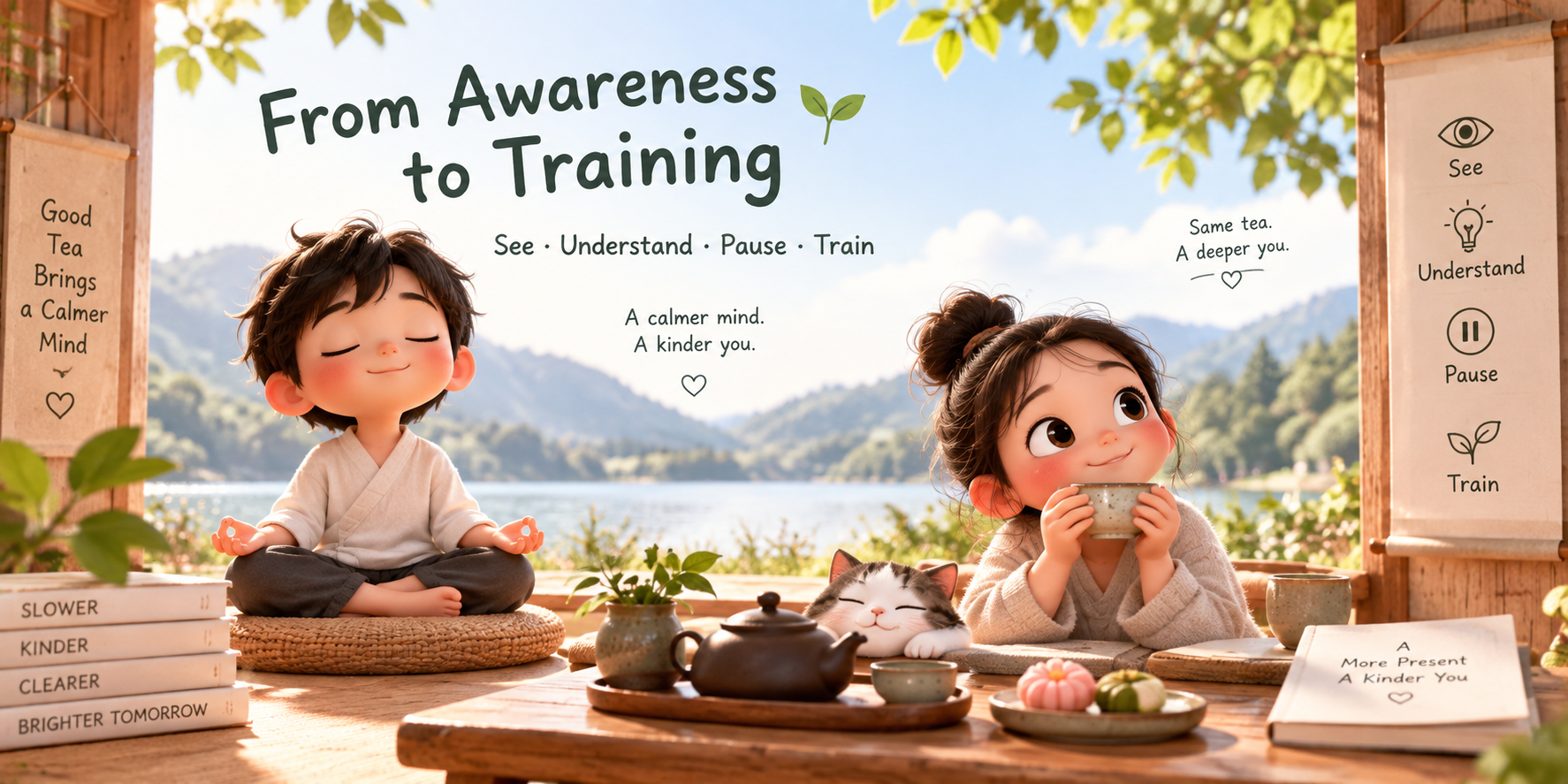
See · Understand · Pause · Train in Zen Tea Meditation
Zen Tea Meditation is not about trying to stop all thoughts or forcing the mind to remain still. The mind naturally moves. Thoughts arise, attention shifts, memories appear, emotions change, and one thought may quickly lead to another. What we are learning is not how to prevent all of this from happening, but how to become increasingly aware of what the mind is actually doing. This is the meaning behind the progression See · Understand · Pause · Train. We first learn to see the mind, then gradually understand how it moves. As awareness and understanding grow, a small space may begin to appear before we automatically react. From there, we can begin to train the mind and learn how to guide it.
The first step is to see. During Zen Tea Meditation, we begin with something very simple and concrete. We notice the color of the tea, the sound of water, its aroma and taste, the warmth of the cup, and sensations in the body. At the same time, we begin to notice what is happening in the mind. Perhaps I am looking at the tea, but suddenly I am thinking about tomorrow. Perhaps I am listening to the sound of water, but my attention has already moved to a conversation from yesterday. Perhaps I taste bitterness, and almost immediately a thought appears: “I don’t like this.”
At this stage, we do not need to change what is happening. We simply learn to notice it. This may sound easy, but it represents an important change. In everyday life, we are often inside a thought without realizing that we are thinking. We react without noticing when the reaction began. Our attention moves from one thing to another, yet we may not know that it has moved. The moment we recognize, “My mind wandered,” we are beginning to see the mind instead of simply being carried along by it. This is why the first step is not control. The first step is awareness.
As we learn to see more clearly, we can gradually begin to understand. Understanding does not mean that we immediately analyze everything or try to explain why we are the way we are. Instead, we continue observing our actual experience and begin to recognize patterns. Where does my mind tend to go? When does it begin to wander? What draws my attention away? What happens after a thought appears? Does one thought immediately lead to another? When does a simple sensory experience turn into judgment, comparison, memory, or emotional reaction?
For example, I may take a sip of tea and taste bitterness. The bitterness itself is a direct sensory experience. A moment later, I think, “I don’t like this.” A reaction has appeared. Then another thought may follow: “The tea I had yesterday was much better.” Now memory and comparison have entered the experience. That thought may remind me of where I was yesterday, who I was with, or something that happened during a conversation. Within only a few moments, the mind has traveled quite far from the original taste of the tea.
When we begin to see this process repeatedly, we are no longer simply noticing isolated thoughts. We are beginning to understand how our own mind moves from one experience to another. Most importantly, this understanding does not come from someone telling us how the mind works. It comes from our own direct observation. We begin to see our own patterns for ourselves.
As awareness becomes clearer, something else may begin to happen. We may start to recognize a thought, feeling, or reaction earlier than before. Instead of realizing what happened only after we have already reacted, we may notice the process while it is happening. In that moment, a little space can begin to appear. This is the pause.

Pause does not mean suppressing our thoughts or emotions. It does not mean that we should not feel angry, worried, disappointed, excited, or afraid. It simply means that we are becoming aware enough to recognize what is happening before automatically following it. Something happens, a feeling arises, a thought appears, and instead of immediately being carried into the next reaction, we may have a moment in which we know, “This is what is happening in my mind right now.”
That pause may be very small. Sometimes it may last only a moment. But even a small pause is meaningful, because awareness has entered the process. Before, something happened and we reacted automatically. Now, something happens and we begin to see our reaction forming. When we can see it, we have a greater possibility of choosing what happens next.
This is where training gradually begins. In Zen Tea Meditation, one of the simplest forms of training is learning to bring the mind back after we notice that it has wandered. Perhaps I am smelling the tea and suddenly realize that I have been thinking about work. I do not need to criticize myself or think that I have failed. I first recognize what happened: my mind wandered. Then I intentionally bring my attention back to the tea. I smell it again, return to the taste, feel the warmth of the cup, or listen again to the sound of water.
A little later, the mind may wander again. I notice it again, and I bring it back again. This may happen many times. The important thing is not how many times the mind wanders. What matters is that we are gradually developing the ability to recognize when it has wandered and to guide it back.
This is why the goal of Zen Tea Meditation is not to create a mind that never moves. A wandering mind does not necessarily mean that the practice has failed. If the mind wanders and we do not know it, we simply continue following wherever it goes. But if the mind wanders and we suddenly recognize, “My mind has wandered,” awareness is already present. Before, the mind wandered and we did not know. Now, it wanders and we see it. Later, perhaps we begin to see it sooner. We may begin to recognize what drew it away, and eventually we become more skillful at bringing it back.
Over time, this practice can extend far beyond a cup of tea. The same process may begin to become visible while we are working, talking with someone, driving, facing stress, or experiencing a difficult emotion. We may begin to recognize the moment when attention moves, when judgment appears, when emotion begins to build, or when one thought starts pulling us into another. The setting is different, but the ability we are developing is the same: we are learning to know what our mind is doing and gradually learning how to guide it.
This is the relationship between See · Understand · Pause · Train. They are not four separate techniques. They are a gradual process. We first see what is actually happening. As we see more clearly, we begin to understand how our own mind moves. As that understanding becomes stronger, we may discover a little space before automatically reacting. Within that space, we have an opportunity to choose, to return, and to train.
Zen Tea Meditation begins with awareness because awareness gives us the possibility of understanding, and understanding gives us the possibility of change. We are not trying to fight with the mind or force it into stillness. We are learning to know it, care for it, guide it, and gradually train it.
And all of this can begin with something as simple as a cup of tea.
See · Understand · Pause · Train.
Learn to see your mind, understand how it moves, and gradually learn to guide it.