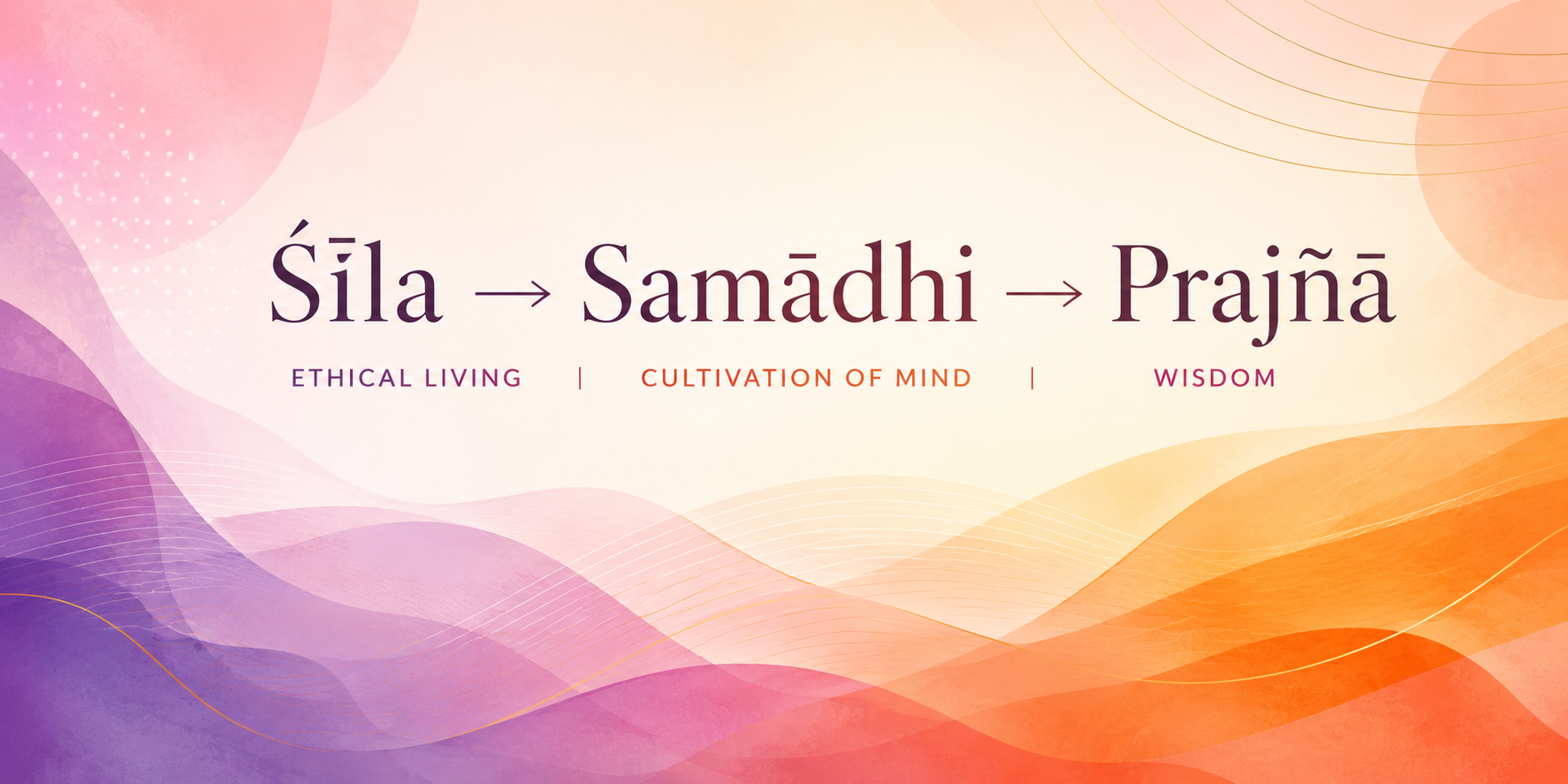
Śīla · Samādhi · Prajñā
The Threefold Training
Buddhist practice is a gradual process of transformation, beginning with how we live and moving inward toward the cultivation of the mind and wisdom.
Śīla brings greater order and peace to our lives.
Samādhi develops a mind that is stable, clear, and strong.
Prajñā is the cultivation and direct realization of wisdom—learning to see ourselves and reality as they truly are.
Śīla creates the conditions for Samādhi. Samādhi, in turn, prepares the mind for the cultivation of wisdom. But concentration itself is not wisdom, nor is it the final goal.
Ultimately, Buddhist teachings are not meant to be understood only as ideas. They are to be practiced, observed, and personally realized through direct experience.
01 · ŚĪLA
Ethical Living
Śīla begins with how we live, speak, and relate to others.
When our actions continually create harm, conflict, or disorder, our lives become unsettled. That outer disturbance inevitably affects the mind, making inner calm and stability much more difficult.
Śīla is therefore more than simply following rules. It helps us reduce the confusion and disturbance created by our own actions, bringing greater order to our lives and creating the conditions for a more peaceful mind.
For lay practitioners, the Five Precepts and Ten Wholesome Actions provide a practical foundation for this training.
02 · SAMĀDHI
Cultivation of Mind
As our lives become more settled, we can begin to train the mind more deeply.
Through mindfulness, meditation, and concentration, a mind that is easily distracted and carried away by thoughts, emotions, and external conditions can gradually become stable, clear, focused, and strong.
But Samādhi is not wisdom.
Its importance is that it prepares the mind for the cultivation of wisdom. A scattered and reactive mind has difficulty seeing clearly. A well-trained and concentrated mind provides the stability and clarity needed for deeper observation and insight. Traditional Buddhist teaching likewise distinguishes concentration from wisdom while presenting concentration as an important support for wisdom.
03 · PRAJÑĀ
Wisdom Through Direct Realization
Prajñā is not simply knowledge, nor is it an intellectual understanding of Buddhist teachings.
Wisdom must be cultivated and personally realized.
Through learning, reflection, practice, and direct observation, what we once understood only as an idea can gradually become something we see and know for ourselves.
The Buddha can show us the path, and teachers can guide our practice, but genuine realization must arise through our own experience.
Buddhism ultimately asks us not only, “What do I believe?” but, “What have I seen and realized for myself?”