From Tea to Everyday Life
Bringing Zen Tea Meditation Beyond the Cup
Zen Tea Meditation begins with a cup of tea, but the practice is not meant to remain at the tea table. What we are training is not simply the ability to stay focused while drinking tea. Through tea, we are learning to recognize how our attention moves, how thoughts arise, how emotions and judgments begin, and how easily the mind can be carried from one experience into another. Once we begin to see these processes clearly during tea practice, we may gradually start to recognize the same patterns in everyday life.
During Zen Tea Meditation, the environment is intentionally simple. We look at the tea, listen to the sound of water, smell its aroma, taste its flavor, and feel the warmth of the cup. Because the experience is simple and concrete, it gives us an opportunity to observe the movement of attention more clearly. I may be listening to the sound of water, for example, and suddenly realize that my mind has moved to something I need to do tomorrow. I may be tasting the tea when a memory appears. I may feel the warmth of the cup and then hear a sound outside that immediately carries my attention somewhere else.
Through repeated practice, we begin to recognize something important: the mind can be carried away very easily. Sometimes it is carried away by something outside us—a sound, a movement, a person, or something we see. Sometimes it is carried away by something within us—a memory, a worry, a physical sensation, an expectation, or an emotion. One small experience can lead to a thought, that thought can lead to another thought, and before we know it, the mind may be far away from what is actually happening in front of us.
This does not happen only when we drink tea. The same process is happening throughout our everyday lives.
Someone says a few words to us, and the mind immediately begins to interpret them. Perhaps we feel criticized. A judgment appears, an emotion begins to build, and before we have clearly recognized what is happening inside us, we may already be responding. A message arrives on our phone and suddenly our attention is somewhere else. While driving, we may begin replaying a conversation from earlier in the day. While working, one thought about tomorrow may lead to ten minutes of worrying about something that has not happened. The circumstances are different, but the movement of the mind is very similar.
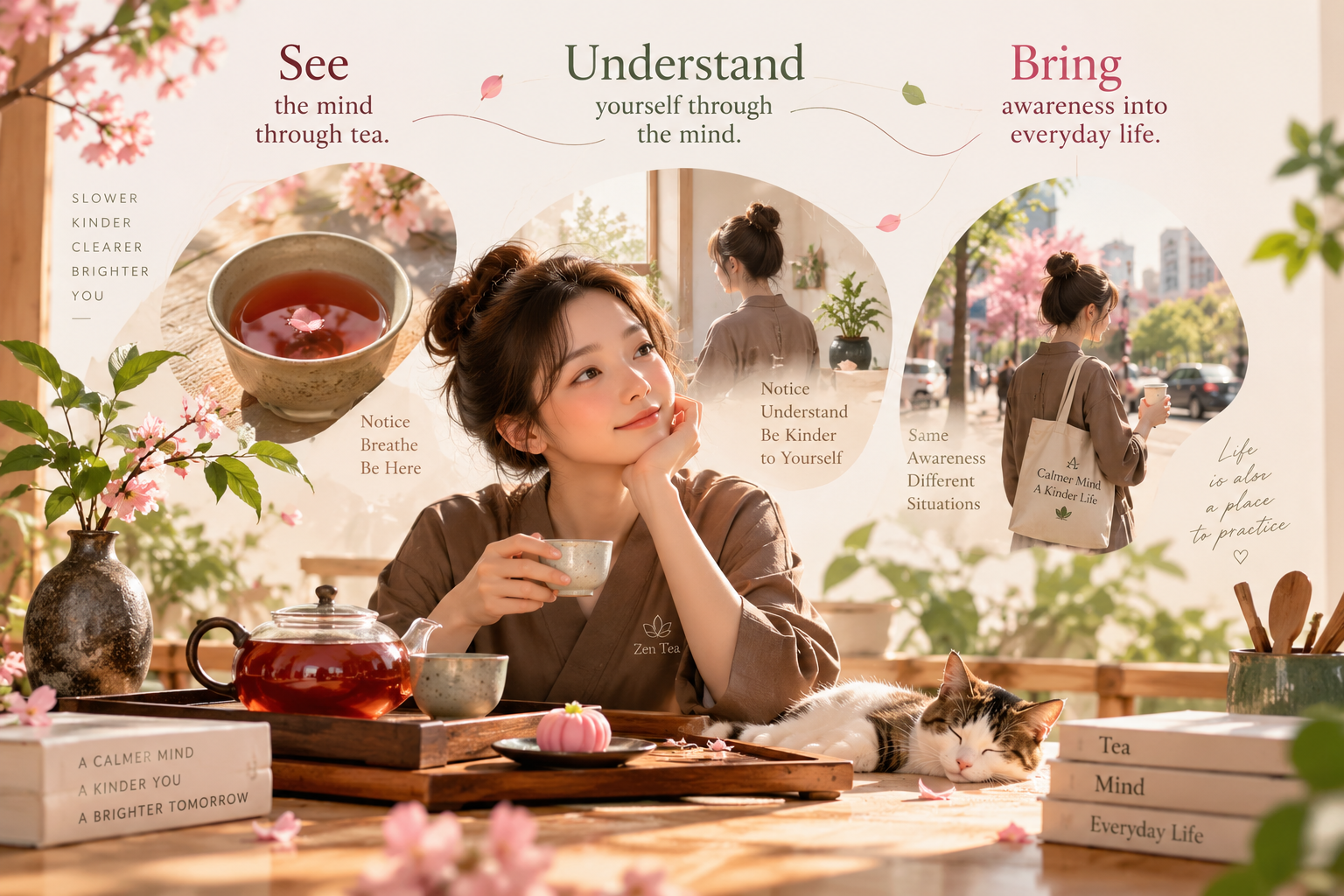
This is where the connection between tea practice and everyday life becomes important. At the tea table, we are practicing in a simpler environment where these movements are easier to see. We learn to notice: My attention moved. A thought appeared. A judgment followed. An emotion is beginning. My mind is being carried away. As this awareness becomes more familiar, we may begin to recognize these same moments outside the practice.
Imagine that someone says something that normally makes us angry. In the past, the words may have immediately triggered a reaction. We hear the words, feel hurt or angry, and respond almost automatically. Later, perhaps we regret what we said or wonder why we reacted so strongly.
With greater awareness, the external event may be exactly the same, and the emotion may still arise. The difference is that we may begin to see the process earlier. We hear the words. We notice the feeling in the body. We recognize that a judgment has appeared. We feel the emotion beginning to build. Instead of discovering all of this only after we have reacted, we begin to recognize it while it is happening.
That recognition creates an opportunity to pause.
The pause does not mean that we suppress the emotion or tell ourselves that we should not feel what we feel. It simply means that awareness has entered the process. Instead of moving immediately from what happened to an automatic reaction, there is now a moment in which we can recognize: “This is what is happening in me right now.”
Within that moment, choice becomes possible.
Perhaps we still choose to speak. Perhaps we decide to wait. Perhaps we take a breath before answering. Perhaps we realize that our first interpretation may not be the only interpretation. The purpose is not to teach ourselves one “correct” response. The important change is that our response has a greater possibility of becoming conscious rather than automatic.
The same principle can apply to stress. Sometimes stress does not arrive all at once. It builds through a series of small mental movements. One problem appears, then the mind begins imagining what might happen next. One possibility leads to another possibility. A physical sensation appears, we interpret it, worry about it, and then worry about the fact that we are worrying. By the time we notice, we may already be deeply caught in the experience.
Zen Tea Meditation gives us a small and manageable place to begin recognizing this kind of movement. At first, we may only notice that the mind has wandered after it has been gone for quite a while. With practice, perhaps we begin to notice sooner. Gradually, we may become more familiar with the moment attention moves, the moment judgment begins, or the moment a thought starts pulling us into another thought.
The purpose is not to monitor ourselves every second of the day. Nor is it to make ourselves afraid of thoughts, emotions, or mind wandering. Thoughts are part of our experience. Emotions are part of our experience. The mind will move. What we are developing is the ability to know more clearly when it is moving and what is happening while it moves.
This is why a simple cup of tea can become meaningful beyond the tea itself. At the tea table, we have a relatively quiet place to practice seeing. Everyday life gives us countless opportunities to continue that practice. Work, relationships, conversations, traffic, waiting, disappointment, excitement, stress, and uncertainty all become places where awareness can gradually become part of how we live.
Over time, we may begin to discover that the real question is no longer simply, “Can I stay focused on my tea?” The deeper questions become: Can I recognize when my attention has been carried away? Can I notice a reaction before it completely takes over? Can I recognize what is happening in my mind while I am speaking to another person? Can I create even a small pause before responding automatically? And when my mind has gone somewhere I do not want it to go, can I gently guide it back?
This is how Zen Tea Meditation moves from practice into life. We begin with something simple enough to observe—a cup of tea—and gradually develop an awareness that can accompany us into more complicated situations.
Tea gives us a place to practice, but everyday life is where that practice begins to matter.
See the mind through tea. Understand yourself through the mind. Bring awareness into everyday life.